
For twenty years, the aim of search marketing has been straightforward: rank #1, get the click, and get the customer. That equation has been broken now. Somebody might find their brand in the first position in the organic results section, but still not read the answer, since the customer doesn’t read a list of links. They read one AI-generated summary, ask one AI assistant, or scroll one Reddit thread that an AI model has determined to be trustworthy. “Search Generative Experience” was what Google initially intended to address in 2023 when introducing it, and though the name has changed to AI Overviews and AI Mode, the change that it helped foster has only continued to accelerate. When brands are looking to see where they are in Anaheim and Orange County, that is no longer the question in 2026. So it is “Does this AI system recommend us at all?”
What "Search Generative Experience" Actually Means Today
The Data Behind Why #1 No Longer Wins
The scale of this shift is no longer speculative. BrightEdge’s one-year analysis found AI Overview presence climbed from roughly 31% of tracked queries in February 2025 to about 48% by February 2026, with longer, more complex queries affected even more heavily. Click-throughs on pages with an AI Overview present have fallen sharply across multiple independent studies, and a 2026 randomized field experiment measured a 38% drop in clicks when an AI Overview appeared. Meanwhile, ChatGPT alone reported roughly 900 million weekly active users in February 2026, more than double its count a year earlier, and platforms like Perplexity are converting citations into clicks at materially higher rates than Google’s AI Overviews because they surface source links more prominently.
The shift, in five numbers
- AI Overviews now appear on roughly 48% of tracked Google queries (BrightEdge, February 2026), up from 31% a year earlier.
- Brands cited inside an AI Overview earn about 120% more organic clicks per impression than uncited brands on the same query (Seer Interactive, 2026).
- Ranking-to-citation overlap has fallen from roughly 70% to under 20% in a single year.
- ChatGPT reported about 900 million weekly active users in February 2026, more than double its total from a year earlier.
- Perplexity’s cited sources see an 18–22% click-through rate, well above the click rate on Google AI Overview citations, because Perplexity surfaces source links more prominently.
Where Answer Engines Actually Get Their Information
The Citation Triad: What Actually Moves the Needle
The Local Layer: What This Means for Anaheim and Orange County Brands
Inside generative engines, visibility is still broad and ripe for risks and opportunities. The AI Overviews are showing up in about 68% of local searches, while the map pack is showing up in 39%, according to a study from Whitespark, reported by Search Engine Journal. In fact, SOCi’s own 2026 Local Visibility Index evaluated almost 350,000 business locations and found that only 1.2% received recommendations from ChatGPT, 11% from Gemini, and 7.4% from Perplexity, compared with 35.9% that appeared in Google’s local 3-pack. According to SOCi, it takes 3 – 30 times more effort to gain AI visibility than it does to rank well in traditional local search now.
Building an AI-Recommended Brand: The Action Framework
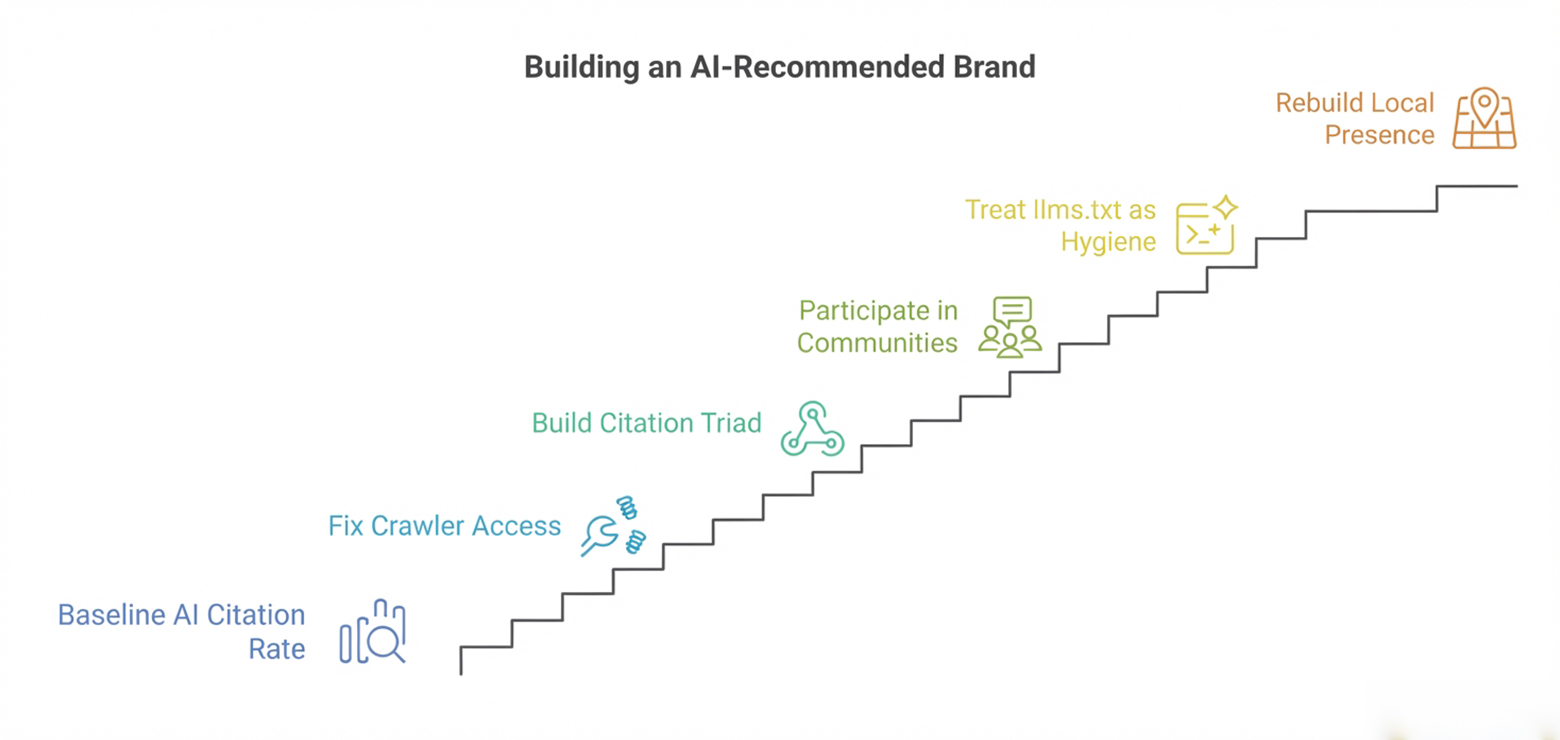
Chasing rankings while ignoring citations is the fastest way to become invisible in exactly the channel your customers are moving into. A practical framework looks like this:
- Baseline your AI citation rate. Query ChatGPT, Perplexity, Gemini, Copilot, and Google’s AI Overviews directly with the questions your customers actually ask, and track whether and how your brand shows up.
- Fix crawler access first. Recent audits have found roughly 73% of sites carry technical barriers, often in robots.txt, that quietly block AI crawlers from reading their content at all. No content strategy survives that.
- Build the Citation Triad into every page. Named statistics, credible external citations, and expert quotations aren’t optional flourishes anymore; they’re the mechanism generative engines use to decide what’s trustworthy enough to repeat.
- Show up in the communities your buyers already trust. Sustained, genuine participation on Reddit and Quora feeds the exact sources ChatGPT, Perplexity, and Google’s AI surfaces cite most.
- Treat llms.txt as cheap hygiene, not a silver bullet. Adoption studies in 2026 put implementation at somewhere between 2% and 10% of sites, and most major AI crawlers still fetch HTML directly rather than requesting the file. It’s roughly an hour of work with real upside for how agentic tools summarize a brand, but it will never compensate for thin content or weak authority.
- Rebuild your local presence around AI-readability, not just map-pack ranking, since the two now reward overlapping but distinct signals.
This is the discipline Chimera Marketing’s AI Search Visibility and AEO/GEO services are built around: auditing where a brand currently stands across every generative engine, then engineering content, structured data, and community presence toward citation, not just clicks.
Ranking Was the Old Finish Line
Frequently Asked Questions
Have Questions About Our Marketing Services? We Have Answers!
What is Search Generative Experience (SGE), and is it still called that?
SGE was Google’s original name for AI-generated answer summaries, previewed in 2023. Google rebranded it AI Overviews in 2024 and later added AI Mode, but “SGE” is still widely searched, so it’s worth targeting even though the product itself now goes by a different name.
Is SGE the same thing as an AI Overview?
Functionally, yes, AI Overviews are the current, officially named version of what Google originally called Search Generative Experience. The core mechanic (an AI-written summary above organic results, pulling from multiple sources) hasn’t changed, only the label has.
Can a business rank #1 on Google and still be invisible in ChatGPT or AI Overviews?
Yes, and it’s increasingly common. The overlap between top-ten Google rankings and AI citation has fallen to under 20% in 2026, because generative engines select sources based on citability and authority signals rather than ranking position alone.
Why do Reddit and Quora show up so often in AI search answers?
AI models treat community discussion as evidence of real-world consensus, not just marketing copy. Reddit alone accounts for close to 40% of all AI citations across major platforms, and combined with Quora, YouTube, and LinkedIn, community content outweighs brand-owned pages in most AI-generated answers.
Do local businesses in Anaheim need a different AI search strategy than national brands?
Largely yes. AI Overviews already appear in roughly 68% of local searches, but most AI platforms recommend only a small fraction of local businesses today, meaning local AI visibility is still an open, low-competition opportunity compared to the crowded traditional local pack.