

What Retrieval-Augmented Generation Actually Means for Your Visibility
How ChatGPT, Gemini, Claude, and Perplexity Retrieve Differently
Each AI platform has its own index where RAG is applied, so one optimization technique doesn’t apply uniformly to each. The search function of ChatGPT is powered by the Bing index, and so is its technical SEO, so it’s important to consider technical SEO for Bing. Google’s Gemini and AI Overviews are based on data in Google’s citation index and heavily rely on Knowledge Graph entity data to determine who to name. Claude’s answers are grounded in web content with the help of Brave Search, and it’s been documented to prefer neutral, verifiable, citation-ready web content over promotional content. Its cited pages convert unusually well since Perplexity retrieves live on almost all the queries and shows more prominent links to the sources that are cited.
Retrieved Isn't Cited: The Filter That's Quietly Killing Your Visibility
Writing Content Structured for Extraction, Not Just for Reading
Where Schema Markup Actually Helps, and Where It Doesn't
Entity Authority Beats Backlinks in the AI Citation Race
AI citations don’t cite pages on their own; they cite entities that they already know. According to a 2025 Semrush correlation study, branded web mentions have a much higher correlation with AI Overview visibility at 0.664 compared to regular backlinks, which have a correlation rate of 0.218. The 2025 Semrush correlation research revealed that branded web mentions have a much greater correlation with AI Overview visibility at 0.664 in comparison with regular backlinks, which have a correlation rate of 0.218, implying that web mentions are a more powerful predictor of AI citation than links.
Deliberate construction of that recognition: a claimed and current Wikidata entry, a consistent Organization schema with matching sameas links throughout your site, LinkedIn, and directories, and named author bios with real credentials linked to each article. More recent studies of citations have revealed that pages with identifiable author entities were accessed at a recognisable level when compared to pages with anonymous or generic authors, given that a model cannot prove a source it can’t identify.
Clear the Crawler Gate Before Anything Else
A Practical RAG Optimization Checklist
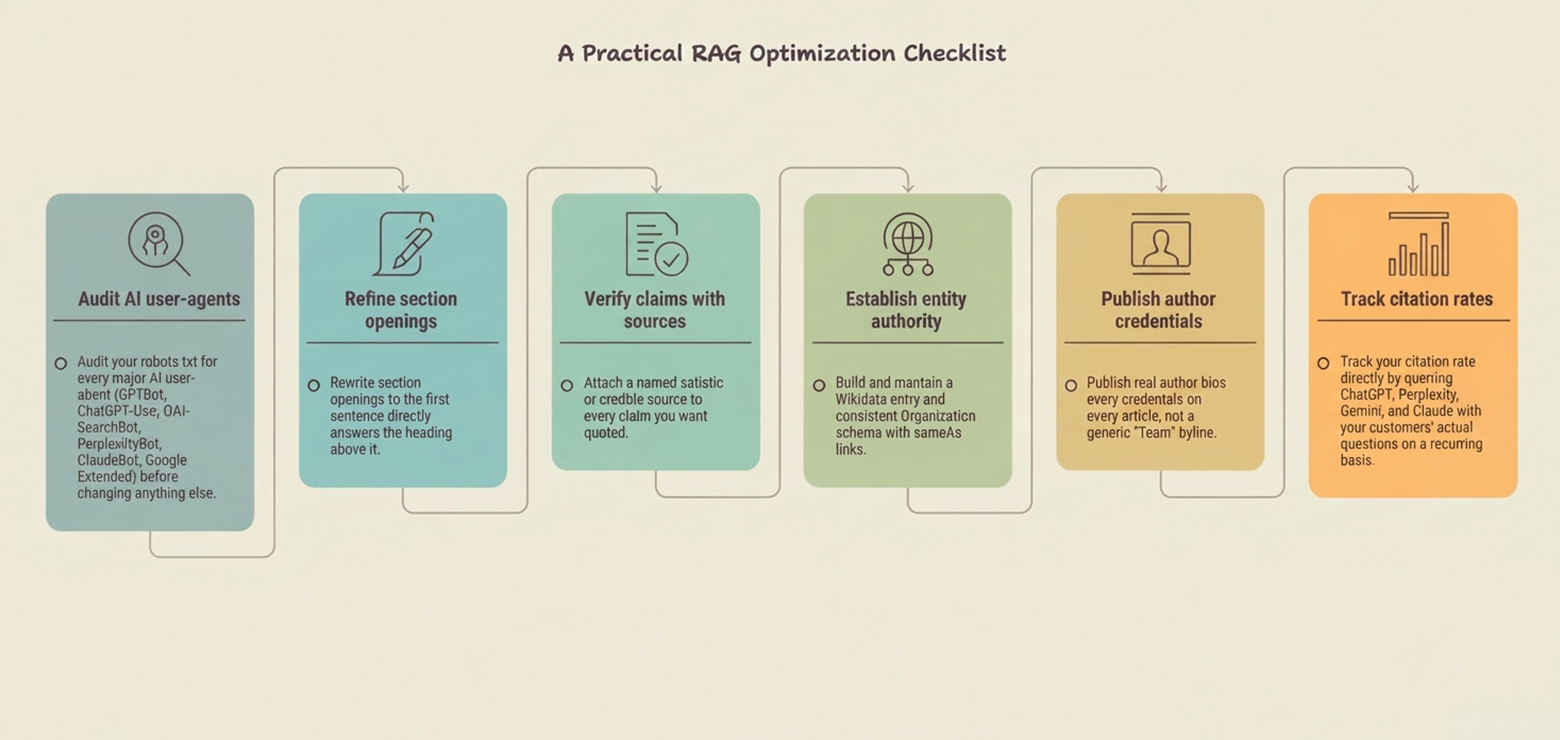
- Audit your robots.txt for every major AI user-agent (GPTBot, ChatGPT-User, OAI-SearchBot, PerplexityBot, ClaudeBot, Google-Extended) before changing anything else.
- Rewrite section openings so the first sentence directly answers the heading above it.
- Attach a named statistic or credible source to every claim you want quoted.
- Build and maintain a Wikidata entry and consistent Organization schema with sameAs links.
- Publish real author bios with credentials on every article, not a generic “Team” byline.
- Track your citation rate directly by querying ChatGPT, Perplexity, Gemini, and Claude with your customers’ actual questions regularly.
Turning AI Citations Into Pipeline
This is precisely the discipline behind AI SEO and GEO services: auditing where a brand currently stands across every generative engine, then building the entity signals, content architecture, and retrieval feeds that turn AI citations into qualified pipeline. If your SEO strategy still stops at rankings, you’re already behind the brands your customers are hearing recommended by name.
Frequently Asked Questions
Have Questions About Our Marketing Services? We Have Answers!
What is Retrieval-Augmented Generation (RAG) in AI search?
RAG is a technology that enables AI models such as ChatGPT and Gemini to access real-time information on the web when prompted with a query, rather than just providing responses based on the information they were trained with. The model is first used to retrieve candidate pages, after which it generates a response based on the retrieved content, meaning that the retrievability is as important as the quality of the writing.
How can I get my brand cited by ChatGPT, Gemini, or Perplexity?
Make sure that your site can be reached by AI crawlers and organize content with clear, direct, and quote-worthy answers, supported by named statistics or sources. Add to that verified entity signals: Wikidata, consistent schema, verified author bylines, as models reference recognized entities much more often than anonymous, uncredited pages.
Does schema markup actually improve AI citations?
Only indirectly. In 2026, controlled studies were conducted that demonstrated that JSON-LD schema by itself did not result in much direct citation lift. It is still useful as machine-readable infrastructure, in terms of authorship and content type, but used in conjunction with good entity authority and content structure, rather than in place of it.
Should I block AI crawlers like GPTBot or PerplexityBot in robots.txt?
If AI citations have significance to your brand. Training data control GPTBot, and it can still be blocked without losing search visibility, but blocking OAI-SearchBot, ChatGPT-User, or PerplexityBot removes you from those platforms’ live retrieval and citations completely, as they are separate and citation-facing bots.
Is llms.txt necessary for AI search visibility?
No! Treat it as optional hygiene, not a strategy. Adoption sits around 10% of sites, and most major AI crawlers still fetch standard HTML rather than requesting the file directly. It costs little to add but won’t offset thin content or weak entity authority.
How is Generative Engine Optimization (GEO) different from traditional SEO?
Traditional SEO is about ranking position, while GEO is about retrieval and citation within AI-generated answers. The overlap between the top-ranked pages and the pages that are cited by AI has significantly decreased, and a top-ranked page can be visible on Google and not inside AI’s answers in ChatGPT, Gemini, or Perplexity.