

Your Content Is Training the Machines: An AI Data Security Guide for Growth-Stage Brands

Thoughts, ideas, and perspectives on design, simplicity, and creative process.

Your Content Is Training the Machines: An AI Data Security Guide for Growth-Stage Brands

Two businesswomen sitting at a conference table with open laptops in a bright, sunlit modern office, engaged in a serious discussion about AI data security policies and protecting brand content from unauthorized machine learning training.

The Quick Fact Check: AI data security for growth-stage brands means controlling two things: what AI crawlers can scrape from your public content, and what your team pastes into AI tools that touch customer data. Both are now regulated, both are exploitable by default, and both need a written policy, not just good intentions.

Whether it’s your team’s blog posts, product pages, or case studies, each of them is being viewed by two groups each quarter. One is human. The other is a crawler, and it’s not in search of customers; it’s in search of examples. Whether it’s pushing the publish button or a stranger approaching you and asking ChatGPT or Gemini a question, then being given a response that is a paraphrase of your words, a decision was made about your content that was never signed off by anyone on your team.

This is not a risk for a $5M-$50M growth stage brand. It’s happening right now and on two different pipelines, and most growth teams are hyper-focused on getting their content indexed and cited, and then don’t pay attention to what happens to it next.

Pipeline One: What Crawlers Are Actually Taking From Your Site

About 70% of the generative AI models have been trained using primarily data from the open web, and all major models, including GPT, Claude, Gemini, and Llama, have been developed by crawling billions of pages. Whether you have or haven’t agreed to it or not, you are in that supply chain.
We now know of over a dozen AI crawlers that are hitting websites, and the key thing most teams don’t realize is that training crawlers add content to a model’s dataset while no one is talking to the website, but retrieval crawlers do retrieve content from the website when someone asks a question, and sometimes with attribution. They can both be operated by the same company. Training and search are now different user-agents, so a site can make a subtle decision: Block GPTBot and Google-Extended, while still being eligible to be referenced in AI answers using their search-facing crawlers.
Like most brands who do not want to deal with the hassle of competing with other brands, robots.txt is the first tool that should be turned to, but there are practical boundaries. It can only indicate to a robot whether it can get a URL; it’s not a lock, and it doesn’t have any legal implications of its own. Real enforcement is at your server or CDN. This is one of the reasons Cloudflare switched from a “blocked unless allowed” to a “default is blocked unless allowed” approach by the time they went live on July 1, 2025.

So what about the fix that some agencies are touting, namely llms.txt? Tell the truth to your client or your team about what it actually does. Google’s own guidance for optimizing for AI seems to explicitly say that llms.txt is not required for generative search features like AI Overviews, AI Mode, or any other generative search feature, and as of 2026, none of the major LLM providers has pledged to crawl it on a regular schedule like Googlebot does with a sitemap. It’s not a visibility tactic; it’s hygiene, especially for agent-facing documentation sites, and it’s definitely not the same as the real work that an AI SEO automation infrastructure can do for you to get you cited, not just crawled.

All of this is happening without any of this as a standalone change from the broader search paradigm shift that has already happened in the zero-click search era affecting clicks to content: the same artificial intelligence systems that wrote the summaries in the answer box are, in many cases, the same systems that trained them.

Pipeline Two: The Leak Nobody's Watching, Your Own Team

Technical and public is a conversation that gets the attention of the crawler. The more dangerous pipeline is noiseless; the more dangerous is a pipeline going through your own people.
In two years, the amount of corporate data that can be considered sensitive has more than tripled, from 10.7% to 34.8%. About three-quarters of employees now copy data directly into generative AI prompts, with 82% of pastes taking place from personal accounts completely outside the company’s purview. To fix it is not a training-data problem. This is your list of customers, your pricing sheet, and your unreleased campaign brief all stored on a third-party server, without any of your access controls.
The cautionary tale which is ubiquitous in enterprise security circles is the Samsung semiconductor company, which banned ChatGPT in May 2023 following the leakage of confidential information by three engineers in just under a month: One pasted confidential source code to troubleshoot an issue, the other shared internal meeting notes for a summary, and the third uploaded manufacturing measurements for a yield calculation. They were all innocent. They all wanted to work faster!
This is the kind of exposure you’re going to get when you’re in a poorly managed CRM or lead pipeline. If you’re putting prospect details into an AI tool to “clean up” a follow-up e-mail, then you’ve already made the same mistake Samsung did, only this time you’re using customer data and not chip designs. That’s why it’s crucial to invest in a lead generation system that doesn’t leak intent and an appointment setting process that doesn’t expose a prospect’s info to an unchecked AI system, as opposed to adding a patch after the fact. The same goes for the information most companies don’t bother to protect: their email and SMS lifecycle data: years of purchases and behavioral data stored in a platform your newest employee can access in two clicks.

The Regulatory Net Is Closing

If it is not enough to move budget with the security argument, then the legal argument should. In December 2023, the New York Times filed a lawsuit for copyright infringement against OpenAI and Microsoft, while Anthropic filed a class action lawsuit for copyright infringement in September 2025, and Reddit sued both Anthropic and Perplexity in 2025. Even before the law passes, there is an indication of where the legal winds are blowing: A bill introduced in February 2026, called the AI Accountability for Publishers Act, would force AI companies to obtain permission and compensation from publishers before scraping any of their content.
On the data front, two frameworks now directly interface with the use of AI on data from growth-stage brands. The EU AI Act mandates high-risk systems to comply with the obligations imposed by the system, which may result in fines of up to €15 million and up to 3% of global annual turnover, with the obligations to become fully applicable for high-risk systems starting on 2 August 2026. This isn’t abstract; it’s a reality if you sell to or process data on EU residents.
Under new regulations in California, which go into effect on January 1, 2026, any company that relies upon AI-assisted hiring, automated underwriting, algorithmic screening, or AI-based algorithmic decisioning will be required to offer a notice in plain language before use as well as an opt-out option or a meaningful human review process. It is the same regulatory current that’s flowing under checkout and customer information, running through the same systems that are providing your customers’ PII at the point of sale.

Why This Hits Growth-Stage Brands Harder Than Enterprise

A $500M enterprise has a general counsel, a CISO, and a dedicated privacy team reading every one of these regulations the week it’s published. A $5M–$50M growth-stage brand usually has a marketing lead, a founder, and a handful of tools stitched together under deadline pressure, with the same legal exposure and none of the same infrastructure to manage it.
Worse, growth-stage brands have more to lose on the content side specifically. Your differentiated point of view, your original research, the brand narrative and creative layer AI models are already learning to imitate- that’s often the entire moat between you and a better-funded competitor. When that content gets absorbed into a general-purpose model with no attribution and no link back, the moat gets thinner every quarter, quietly, with no alert going off anywhere.

A Practical AI Data Security Framework for the Next 90 Days
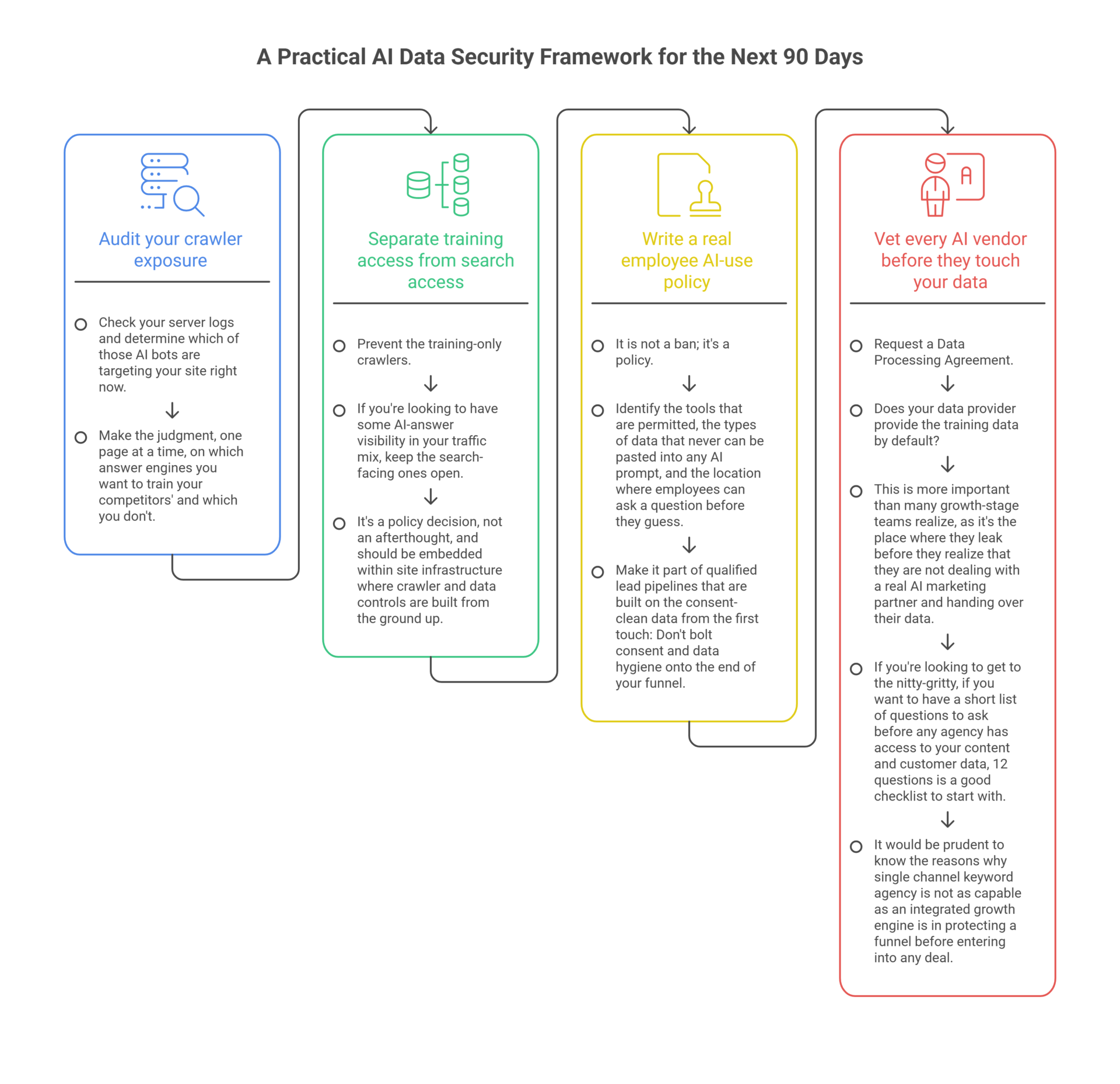
a comprehensive 90-days workplan through which a growth infrastructure model agency can make everything work better
You don’t need a security department to start closing this gap. You need four decisions made deliberately instead of by default.

Audit your crawler exposure

Check your server logs and determine which of those AI bots are targeting your site right now. Make the judgment, one page at a time, on which answer engines you want to train your competitors’ and which you don’t.

Separate training access from search access

Prevent the training-only crawlers. If you’re looking to have some AI-answer visibility in your traffic mix, keep the search-facing ones open. It’s a policy decision, not an afterthought, and should be embedded within site infrastructure where crawler and data controls are built from the ground up.

Write a real employee AI-use policy

It is not a ban; it’s a policy. Identify the tools that are permitted, the types of data that never can be pasted into any AI prompt, and the location where employees can ask a question before they guess. Make it part of qualified lead pipelines that are built on the consent-clean data from the first touch: Don’t bolt consent and data hygiene onto the end of your funnel.

Vet every AI vendor before they touch your data

Request a Data Processing Agreement. Does your data provider provide the training data by default? This is more important than many growth-stage teams realize, as it’s the place where they leak before they realize that they are not dealing with a real AI marketing partner and handing over their data. If you’re looking to get to the nitty-gritty, if you want to have a short list of questions to ask before any agency has access to your content and customer data, 12 questions is a good checklist to start with, and it would be prudent to know the reasons why single channel keyword agency is not as capable as an integrated growth engine is in protecting a funnel before entering into any deal.

Conclusion: Turn Your Data Security into a Revenue Advantage

This is not an excuse to “disappear” from AI search altogether, because all of this is a risk to take in exchange for a larger risk: how much discovery is going on inside AI answers? It’s a justification to make a conscious decision. Brands which can demonstrate to a customer, a partner or a regulator how data is being managed will beat those who are discovering after a breach.

It’s an infrastructure issue, not a marketing one, so it works best as part of an integrated Growth OS that unifies content, data, and traffic as one system, and not as an afterthought to a marketing plan after the fact.
If you are uncertain about where your exposure is, this is the best place to begin. Book a content, data, and growth infrastructure audit and have the written answer before it is found by an AI tool, competitor, or regulator.

Frequently Asked Questions

Have Questions About Our Marketing Services? We Have Answers!

Yes, by default. Most AI crawlers assume open access unless you explicitly block them through robots.txt or server-level rules, and enforcement depends on the crawler choosing to comply.

 It depends on the crawler type. Training-only bots (like GPTBot in training mode or Google-Extended) take content with no traffic in return. Search/retrieval bots can drive AI-answer visibility. Most brands benefit from blocking the former while allowing the latter.

For most marketing and ecommerce sites, no, Google’s own guidance says it doesn’t affect AI Overviews or AI Mode visibility. It’s more relevant for developer documentation and agent-facing technical sites.

 On free and standard consumer plans, that data may be logged and, depending on settings, used to improve future models, creating both a security and a regulatory exposure, especially for PII.

If you process data on EU residents or operate AI systems affecting them, yes. High-risk system obligations become fully enforceable on August 2, 2026.


To Get Started, Simply Fill Out
The Form Below!