Over the last 15 years, ranking meant three blue pins in the Map Pack, a website appearing in the top five organic results, and perhaps several reviews that convinced a potential customer to click through. That scoreboard created whole agency business models. It has also lost its relevance just like that.
When a buyer of a $10M–$50M+ vendor is considering a relationship with the vendor, they are not mapping a neighborhood. They’re asking ChatGPT about other companies that use it, asking Perplexity to compare three names that have been shortlisted side by side, asking Gemini to summarize a category before the first sales call. The number of B2B buyers using AI search as a primary research tool is over 89% (according to recent industry research) and the buying committee behind each of those queries has expanded as well. Forrester’s data shows the average number of internal stakeholders involved in each enterprise purchase decision is 13, with an average of nine external influencers. A Map Pack listing doesn’t answer any of their questions. An AI answer either calls you by your name, or it doesn’t.
The challenge that the best AI SEO agency in Anaheim, CA must overcome is quite different than what local SEO is designed for.
Local Ranking Was Never the Ceiling, It Was the Floor
The visibility of Map Packs is still an issue. It’s no longer the finish line that generative engines sit on top of, it’s table stakes. The winner of the local 3-pack can be completely forgotten the second a customer queries, “Which vendor can I trust with a seven-figure engagement? The second one is not a Google Business Profile signal. It filters through clarity of entities, third-party evidence, and content that can be understood and referenced by a language model.
The companies that get two points must consider that locality is the starting point and not the goal. With the market so thick and effective, Orange County is a manageable area in which to test citation strategy before rolling it out statewide and nationwide; that’s what we did with our zero-click search reality research for AI agencies, and it can be done in any market.
Why Re-Engineering, Not Rewriting, Is the Right Verb
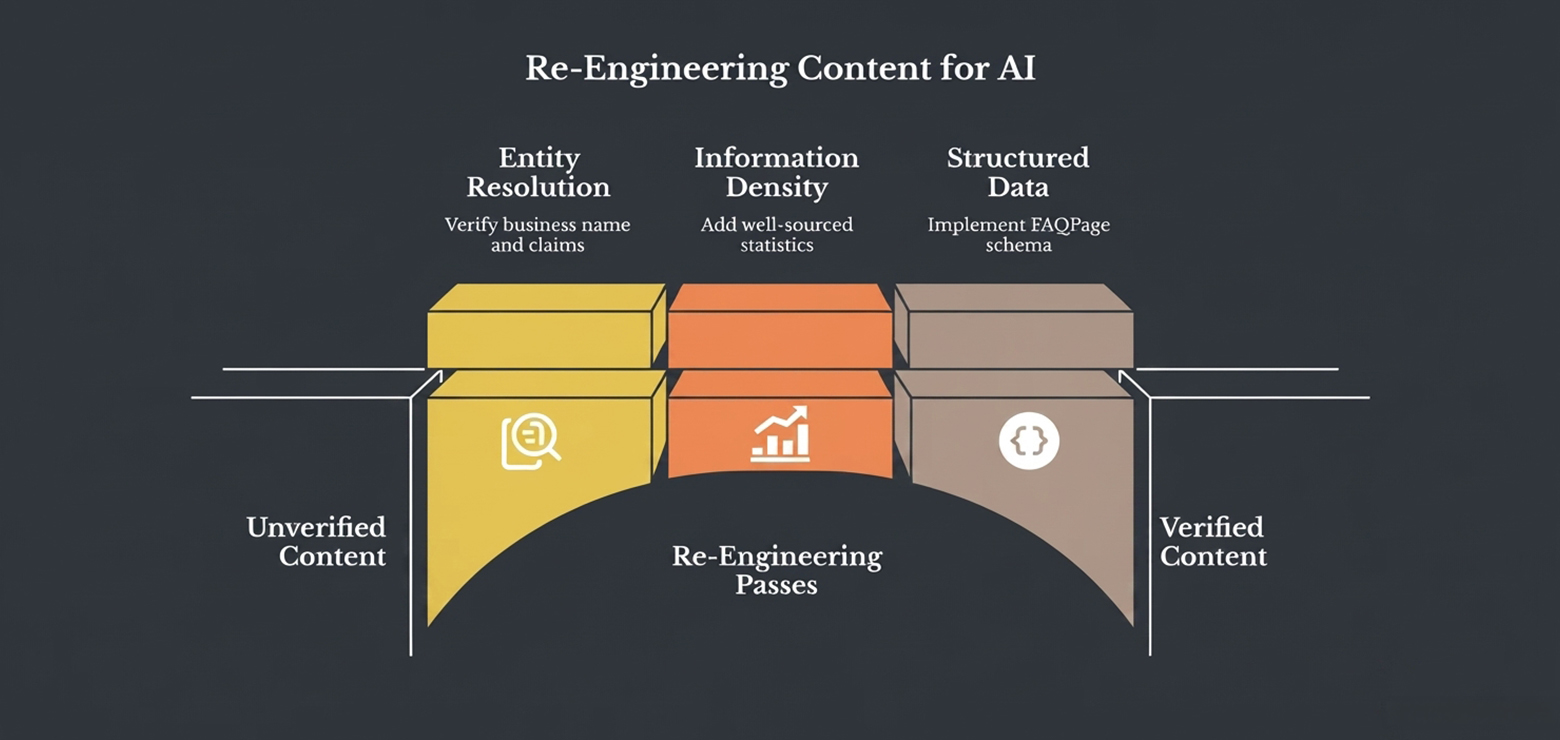
“Content refresh” undersells what generative engines actually require. AI Overviews, ChatGPT, and Perplexity don’t reward more words about the same topic; they reward information they can verify and reuse without ambiguity. That means the work starts below the content layer entirely, with three re-engineering passes most agencies skip because they don’t show up on a rank tracker.
1. Entity Resolution Before Content Production
A generative engine must be confident that your business name, your category, and your claims all refer to the same verified entity if it’s going to risk a citation to you in an answer. Even if the blog post below is great, inconsistent NAP data, schema mismatch, or a brand listed in 3 different names in directories is noise to a model, and noise doesn’t get cited. This is a diagnostic job, and it’s typically the most leveraged repair that we do before a client asks us to write a new page.
2. Information Density Over Keyword Density
Looking at the results of the GEO study run by Princeton, which compared the ranking of nine different optimization methods with 10,000 actual queries, keyword-stuffed content actually scored worse than doing nothing, while the single best optimization method yielded more than a 40% visibility increase, with simply compiling lists of well-sourced statistics. Nothing else should replace the “publish more” playbook other than that fact. Generative engines match names, numbers, dates, and claims that are attributed to a passage, not repetition. Content which is designed for citation looks more like a well-sourced short piece than a marketing page.
3. Structured Data as Distribution Infrastructure
It’s not just about making your FAQ page look pretty; it’s about making it readable with schema and comparison tables. Structured data implementations have been found to boost citation rates by more than 3.5 times when implemented on their own, as they provide a pre-parsed answer to the generative engine rather than requiring it to deduce one from prose. This is the layer that our AI SEO Automation work builds around: to make a brand machine-readable before it ever gets machine-recommended.
The Content Format Gap Most Agencies Still Miss
The AI answer layer is much more dependent on format than the organic search layer. The largest share of AI citations by content type is comparison-based content, followed by opinion and analysis, while product pages and generic service descriptions make minimal headway. That is a straight repudiation of the “publish consistently” mantra that’s still being trotted out by most GEO commentary. A well-informed comparison piece with a clear opinion and numbers will beat a month’s worth of blog posts that are just cut and pasted from a template. When a model chooses rather than a person, volume is irrelevant; depth and structure is the game.
This is the same conclusion we reached in The Generative Engine Shift: agencies still selling blog-post quotas are optimizing for a scoreboard that generative engines have already stopped using.
The Revenue Case: Why This Isn't Just a Visibility Play
What should change the entire conversation for an enterprise finance team considering this spend is that AI-referred traffic isn’t just more frequent; it also has an astounding conversion rate once it arrives. According to independent analytics research, visitors who came to your website via ChatGPT are more likely to convert, with rates hovering around 16% and for traditional organic search traffic under 2%. Ahrefs saw less than 1% of visitors coming in via AI search, resulting in over 12% of signups. Less than 1% of traffic was being driven from AI search, yet it was responsible for more than 12% of signups. The mechanism is straightforward – your buyer who came to your website via AI answer has already been pre-qualified by the model, has a pre-formed short list, and is evaluating, not browsing.
We believe in the difference between immediate impressions and pipeline, and that’s what we strive for with every engagement. No fake impressions here, no “mentions” board to replace a revenue discussion. The same goes for AI SEO vendors: if there’s no traceability from the channel where the citation came from to a qualified lead, the reporting isn’t complete- one of the elements we fully developed in the AI visibility attribution framework.
What "Re-Engineered" Actually Looks Like in 90 Days
A brand that has been properly re-engineered for generative engines, rather than lightly optimized, shows up differently across three measurable layers:
- Citation presence: appearing in AI-generated answers for the specific, high-intent prompts a real buyer would type, not vanity queries with no commercial value behind them
- Source attribution: a clear map of which channel (owned content, earned media, community activity) is actually producing citation gains, so the next budget decision is based on evidence instead of guesswork
- Downstream conversion: branded search lift and qualified lead volume in the weeks following a citation gain, because a rising mention count that never touches revenue isn’t a result; it’s a vanity metric with better production values
Enterprise buyers comparing the best AI SEO agency in California to a rebranded content vendor should ask every candidate to walk through these three layers before signing anything. If the answer stops at “we’ll get you mentioned more,” that’s the gap our enterprise-level AI SEO services are specifically built to close.
Final Thoughts
The Map Pack will not be discontinued and shouldn’t be ignored, as it remains the quickest, cleanest way to test what works before trying the strategy on a statewide or even national scale. However, when you consider it as the destination instead of the on-ramp, that’s when a truly robust local business becomes invisible to the buyer once they ask a question that becomes more complex than “near me.” The businesses recommended over the next year will be neither the ones with the most posts on their blogs nor the businesses with the highest ranking in Map Pack. It’s the ones that will have an unambiguous entity, the ones that will have verifiable sources, and the ones that will have a structure that a model can find and believe, not a human.
It’s not a question of whether generative engines will impact the next RFP for any $10M–$50M+ company considering it now. They already do. Now, the only thing you need to figure out is whether your brand is the brand that the model recommends or a different brand that it skips in favor of a competitor that did this first.