

The Underrated AI SEO Strategies That Are Working Right Now

Thoughts, ideas, and perspectives on design, simplicity, and creative process.

The Underrated AI SEO Strategies That Are Working Right Now

A senior male speaker in a blue sweater presenting growth charts on a flipchart to a group of executives, demonstrating underrated AI SEO strategies that drive organic traffic
Every AI SEO strategies 2026 roundup covers the same four things: add schema, improve E-E-A-T, write comprehensive content, get backlinks. All true. None of it is underrated anymore; it’s the baseline every competent agency already does. What actually separates brands winning AI citations right now from brands still watching impressions climb? At the same time, sessions fall is a second layer of tactics almost nobody is writing about publicly, because most agencies either haven’t built them yet or don’t want competitors to know they work.

Selective Bot Governance, Not Blanket Blocking or Blanket Access

There are basically two lazy approaches to dealing with AI crawlers: block with a hostile robots.txt or simply ignore the question altogether and allow any bot in. Both are very underrated missteps. If you block all AI crawlers, you will also stop users from being cited by ChatGPT, Perplexity, and AI Overviews. If you let everything in indiscriminately, all of your crawlers will get the same access; some will be used for model training, and others won’t be able to send you a citation or a visitor.

The lightly promoted one is differentiated bot governance, meaning you’ll give retrieval/grounding crawlers (the kind that pulls content from the web to answer a specific query) full access to your commercial and cornerstone content, and you’ll explicitly and explicitly decide, case by case, whether or not to allow crawlers to index it. Previously we’ve explored this concept in more detail: which crawlers deserve access and which do not, and this is the most under-executed of the technical tactics on this list; it requires someone to actually look at server logs rather than copying a generic robots.txt template.

Optimizing for Query Fan-Out, Not Just the Literal Search Term

When Google’s AI Overviews or AI Mode processes a query, they don’t only fetch pages with the exact words entered into the search bar; they internally break down the query into a series of sub-questions, fetch content for each of these sub-queries, and then put together the ‘all-answered’ response. This is known as query fan-out, and is the case where the literal words the searcher enters are just one of the many questions that your content actually needs to address in order to be brought into the synthesis.
The majority of the content continues to be created based on one specific phrase. Content for fan-out assumes that (assuming a buyer is next to you) the next three or four questions that the buyer might want to ask are: It’s a really underrated approach, as it eliminates the single-keyword thinking approach, which is not easy for teams who still rely on keyword rank as the main KPI.

Hybrid Semantic Clustering Over Keyword Lists

The traditional approach to keyword research generates a list of phrases in a spreadsheet, ranked by search volume and keyword difficulty. It was designed to house 10 blue links, and it’s becoming the wrong place for a search economy that rewards citation over rank placement. Hybrid semantic clustering is replacing the keyword list with an entity map: each concept, product category, or question asked by a buyer in your category is connected to others, in the same way your own LLM would connect them, and content is created to speak to a cluster in full.

The real-world version of this is an entity-based content checklist which is applied to the content before the first word is written. The questions are: Is this piece of content a complete and clearly defined entity within the cluster, and does it connect to and rely on other entities in the cluster? This is the same architecture that makes or breaks whether an LLM cites a brand or not. Entity clarity is part of five signals, and it’s impossible to build it from a list of keywords.

Programmatic AEO, Schema and Internal Linking at Scale

Adding FAQ schema, HowTo schema, and JSON-LD markup manually, one page at a time, doesn’t scale beyond a few dozen URLs, which is why most sites do not have consistent, complete structured data across their content library. The overlooked solution: schema generation and internal linking as a programmatic layer, not page by page: an architecture of content where every new page automatically has the correct type of schema, automatically receives algorithmic links to the closest topic-cluster neighbors, and is automatically marked if it is missing the schema an LLM crawler would need to accurately interpret it.
This isn’t manual AEO; it’s actually an automated way of doing AEO at scale, which is the only way to sustain a thousand pages of citations when an agency has only got a couple of hours to bill for in the day.

Measuring Share of Model, Not Just Rank Position

Almost no one is pricing this: ChatGPT’s share of AI chatbot traffic dropped from ~79-87% a year ago to somewhere in the mid-50s to mid-60s% by mid-2026, and Claude’s share has seen several-fold growth while Gemini has had the fastest quarterly growth of any major platform. An optimization strategy that focuses solely on ChatGPT citations in 2026 is targeting an increasingly smaller market segment. That’s why we are tracking what we call ‘Share of Model’ internally: the percentage of relevant AI-generated answers in each of the platforms (ChatGPT, Gemini, Perplexity, and Claude) at the same time in which a brand appears, not just any single platform’s citation rate in isolation.
In tandem with that is what we refer to as Search Synthesis Share: the proportion of a brand’s own language, framing, or data point that it makes it into the synthesized answer, rather than merely one among several unrelated sources that the engine may have looked at and ignored. Both of these are not measurable by rank position or click-through data, which is why, when it comes time to make budget decisions, it’s time to look at citation frequency data from platforms, not just ranking reports.

Pre-Publish E-E-A-T and Extractability Verification

Almost no one is pricing this: ChatGPT’s share of AI chatbot traffic dropped from ~79-87% a year ago to somewhere in the mid-50s to mid-60s% by mid-2026, and Claude’s share has seen several-fold growth while Gemini has had the fastest quarterly growth of any major platform. An optimization strategy that focuses solely on ChatGPT citations in 2026 is targeting an increasingly smaller market segment. That’s why we are tracking what we call ‘Share of Model’ internally: the percentage of relevant AI-generated answers in each of the platforms (ChatGPT, Gemini, Perplexity, and Claude) at the same time in which a brand appears, not just any single platform’s citation rate in isolation.
In tandem with that is what we refer to as Search Synthesis Share: the proportion of a brand’s own language, framing, or data point that it makes it into the synthesized answer, rather than merely one among several unrelated sources that the engine may have looked at and ignored. Both of these are not measurable by rank position or click-through data, which is why, when it comes time to make budget decisions, it’s time to look at citation frequency data from platforms, not just ranking reports.

Agentic Workflows for Authority Building

Link building and digital PR outreach have historically been the most manually intensive, least scalable part of any SEO program: one strategist, sending personalized pitches, one publication at a time. Agentic workflows change the constraint: an AI agent handling prospect research, personalization, and first-touch outreach at a volume no manual team can match, with a human strategist reviewing and approving before anything goes out, rather than writing every message from scratch.

This is underrated specifically because most agencies are still pitching “we do outreach” as a headcount story instead of a systems story, and off-site mentions remain one of the five signals that determine AI citation eligibility in the first place, which means authority-building can’t be the one link in the chain still running at 2019 speed while everything else scales.

ROI Modeling Tied to Topic Clusters, Not Vanity Traffic

The last underrated tactic isn’t technical; it’s financial discipline. ROI case is not modeled on specific traffic volume, but rather on the traffic volume validated by the pipeline that the cluster will be expected to generate. A traffic-based ROI model will tell you to focus on content that doesn’t convert, while overlooking the smaller but more precisely targeted content that will generate qualified leads. It is the enterprise teams that can prove ROI based on pipeline that will still be able to continue to justify a content budget line a year later. It’s the enterprise teams who can point to ROI based on pipeline that will still be able to justify a content budget line a year on.

Why This Matters at the Enterprise Level
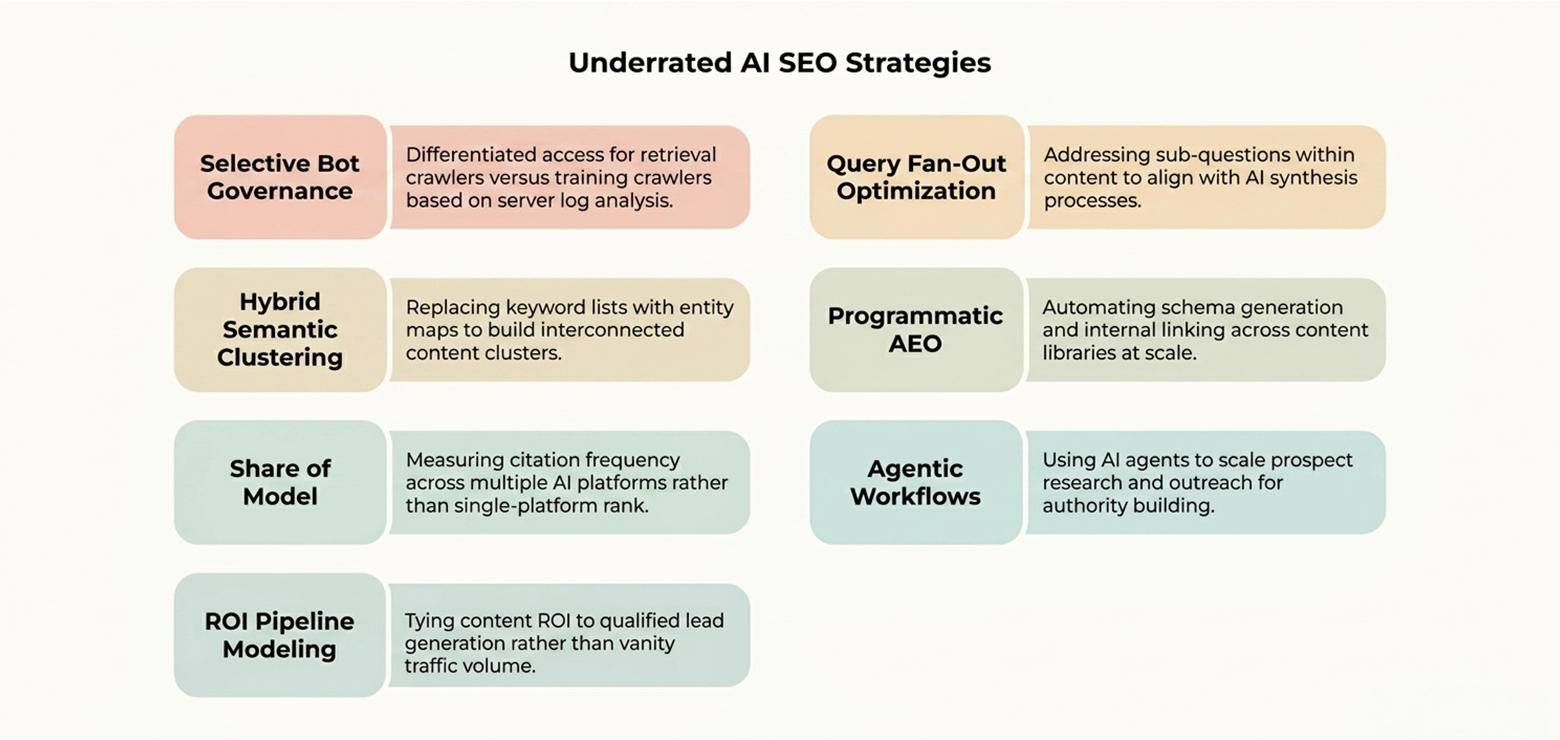
a comprehensive visual flowchart of certain AI SEO strategies that are underrated but they are still working and performing well for relavant businesses
If the company doesn’t have the resources to run eight different tactics at once to experiment and find what works, then spending has to be based on the evidence that already exists. Because of this, this list is presented in the order that they are the lowest-cost methods to implement and protect the foundation, highest ROI to model, least expensive to spend on once the foundation has been proven, and highest potential to return a cost-effective benefit, respectively.

This is not an old SEO agency that added an “AI” section to their services page; it’s the exact sequence our AI-powered search marketing solutions are designed to follow for enterprise clients throughout California and the entire country. If you’re considering the real-life effectiveness of any AI SEO agency in Anaheim, CA, beyond the pitch deck, this list is a good indicator to compare them against, including us.

Book an AI search visibility audit with Chimera, and discover which of these 8 tactics you are already missing in your program.

Frequently Asked Questions

Have Questions About Our Marketing Services? We Have Answers!

JSON-LD structured data, especially the FAQPage, Article with author credentials, and Organization schema – provides an explicit, machine-readable cue to the AI crawler about the meaning of a page and who is responsible for the claim, beyond and in addition to what helps traditional Google rankings.

Try out any main claim and see if it functions as a standalone response without surrounding context, since a sentence that requires paragraph-level context to make sense will not be included in an AI-generated synthesis.

It’s the frequency at which a specific term or fact appears in an AI engine’s answer, as opposed to it being among a handful of sources it referenced but then ignored, a clearer indicator than mere tracking of citation counts.

The referral-string tracking from ChatGPT, Perplexity, and Gemini has become a common traffic source in regular analytics, but most of the research that’s now taking place as a direct result of an AI interaction occurs without any clicks, making it necessary to combine with citation-frequency analytics methodology for a full picture.

A deep audit can show gaps in brand mentions on all major AI platforms, compare the number of mentions against named competitors, investigate entity and schema setup, and reveal queries where a brand is not being recognized by the models that its buyers are already using. This audit is offered at no cost or commitment for Chimera to work with you, and as the initial stage of any AI SEO work.

The entity-cluster mapping outlined above is designed to prevent cannibalisation; it isn’t written on top of existing pages and tidied up afterwards, but is used to ensure that there is no overlap in topics between new pages in the sense that the pages wouldn’t be published if they were different to what’s already available.


To Get Started, Simply Fill Out
The Form Below!