

The Scale of the Shift
Part of the single-channel SEO reporting is left entirely unaccounted for: visibility within the zero-click answer, even without a session. On the same results page, pages that are cited as a source within an AI Overview actually attract significantly more clicks than pages that are not cited at all, the study by Seer Interactive showed when examining the clicks for 53 brands across 5.47 million queries. The study by Seer Interactive revealed that pages that were cited as a source within the AI Overview page do indeed attract measurably more clicks than pages that weren’t cited at all on the same results page, though they did not attract as many clicks as the pre-AI-Overview baseline. Failure mode 1 is “being invisible,” and failure mode 2 is “being uncited” – the latter is solvable while the former isn’t.
Where It Actually Hurts, And Where It Doesn't
What Top AI Agencies Are Actually Doing About It
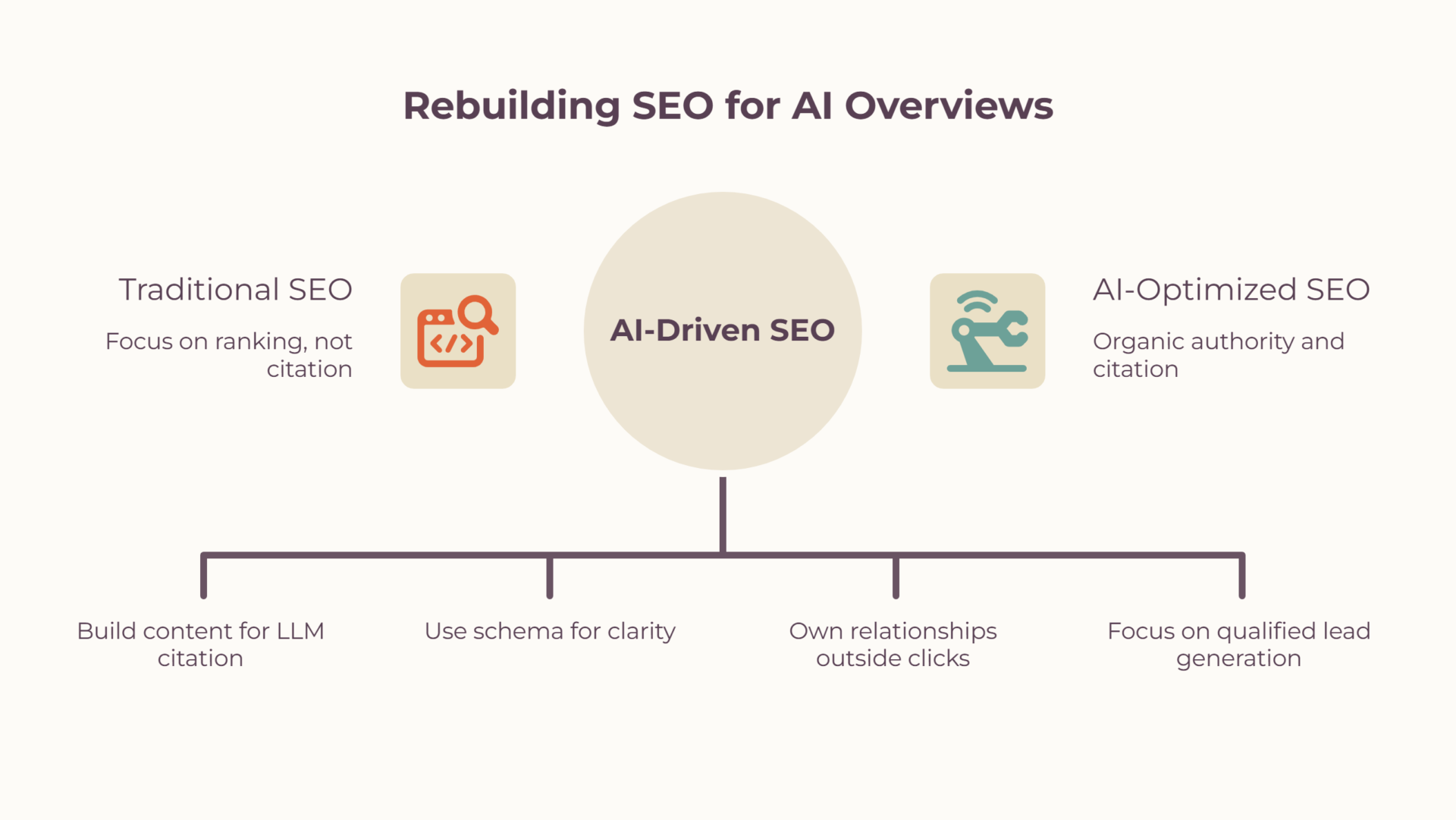
They're engineering content to be citable, not just rankable
They're treating structured data as required infrastructure, not an afterthought
No longer are these schema elements like FAQ schema, HowTo schema, and Organization schema mandatory; they are a clear way of telling Google and all LLM crawlers what a page is about and who is responsible for the claim. A site with clean technical infrastructure and a fragmented one behave very differently in an AI Overview’s source selection; that’s why it is under everything else in a real AI-visibility strategy to move through smoothly and unfrustrated with both a human buyer and an AI crawler.
They're rebuilding revenue capture outside the click entirely
And critically, they're separating traffic volume from lead quality
Why This Hits $5M–$10M Companies Harder
The same structural reason why single-channel SEO retainers are on their way to becoming a liability instead of just a tactic that’s not enough: when volume of clicks is the thing that’s structurally declining, there will be no answer from the vendor that depends on it for their business model. And that’s why the transition to an integrated Growth OS infrastructure is happening first in fast-growing regions like Orange County; companies that are closing this gap the quickest are treating AI visibility as a part of the same system that is responsible for everything else in the funnel.
The Click Was Never the Whole Point
Zero-click search isn’t a crisis to survive. It’s a redistribution of where value gets captured, and the businesses treating it that way are already ahead of the ones still waiting for click volume to come back. It won’t.
Book a growth infrastructure audit with Chimera and see exactly where your current strategy is still optimizing for a click that increasingly isn’t coming.
Frequently Asked Questions
Have Questions About Our Marketing Services? We Have Answers!
My Google Search Console shows impressions climbing but clicks falling every month. Is my SEO agency doing something wrong, or is this happening to everyone?
This is the one thing that people are most frustrated about. Then redefine it as the industry-wide “Great Divergence” (68% of zero-click) and pivot to why Chimera’s now reporting revenue instead of impressions and rankings, directly undermining the old ad agency gamers of keyword-position reports.
If AI Overviews are answering most searches before anyone even reaches a website, is it still worth paying for content marketing and SEO in 2026?
The question that every CFO asks their marketing leader: “Why should we invest in you? The first question that every CFO asks their marketing leader is, “Why should we invest in you? In the answer, they rephrase the buy-clicks-to-buy-citations (the pivot of Chimera’s AI SEO / AEO-GEO service) stat as 35%-more-clicks / 91%-more-paid-clicks.
How do I actually check if my business is being cited inside ChatGPT, Gemini, or Perplexity answers, or if I'm invisible to AI search entirely?
A question that requires a diagnosis and action, has actual search volume, and isn’t a question that most agencies can answer, and that’s because they don’t provide the audit. The concrete next step is answering the 7-point entity-mapping and schema audit that Chimera presented in the same language as it already used in the Aug 5 teardown article.
We rank #1 in Anaheim/Orange County for our main keywords, but our traffic keeps dropping. What's actually going on?
Hyper-local long-tail intent that no national competitor’s blog will rank for, and it caters towards the current OC cluster. Answer describes why #1 rankings won’t necessarily drive click-throughs with the growth of SERP features and AI Overviews, and explains the difference between a fragmented single-channel agency and Chimera’s one integrated agency approach.
Since fewer people are clicking through at all, how do we make sure the visitors we do get actually turn into paying customers instead of just browsing?
This is the most valuable question; it is the bottom-of-the-funnel question: it assumes the traffic problem, and subsequently asks a conversion question, which is where Chimera’s Conversion + Retention layers fit in. This clarifies the “referral quality effect”, which represents an SEO natural upsell versus pure CRO/landing page/retention effect: surviving clicks convert better, because visitors are higher-intent.