
This is the fact: a lot of top $5M–$10M companies in Anaheim, CA are still building their marketing budget around a single-channel SEO retainer that was designed for a search engine that no longer works the way it did when the retainer was priced. This piece is about what’s replacing it, why the replacement only makes commercial sense once a company is large enough to feel the compounding cost of staying single-channel, and how to tell an agency that’s actually built for this from one that’s added a slide.
Part I: Why Single-Channel SEO Is Dying
Keyword rankings at the keyword level no longer forecast revenue as before. The #1 ranking of a commercial-intent keyword used to ensure a guaranteed number of clicks. Nor does it anymore, when an increasing percentage of the same questions now receive answers within an AI Overview or a Perplexity/ChatGPT answer before the organic results are even scrolled to. The keyword agency’s whole business is being slowly eroded from the bottom up, bit by bit, one query type at a time, while the bill for retaining the same agency remains unchanged.
Part II: The Replacement Model, What an "AI Growth Engine" Actually Is
So this raises some questions with a company considering the conversion:
What is meant by the term “AI growth engine”? Is it a new tool or a different team organization? What would be the benefit of using one growth infrastructure model versus having five vendors, particularly when a company is already spending money on its own for all three? How exactly is content produced differently when it is created for GEO/AEO and traditional SEO, rather than for one channel and then hoped to perform well in the other?
Part III: Why This Is Specifically an Enterprise Problem
Part IV: The Proof Layer, How to Tell a Real AI Growth Engine From a Relabeled Pitch
The content layer itself has shifted, as well, under the legacies of content production: What if your best content becomes the raw materials for an AI overview? It is also important to be aware of how Google’s own new guidance has already shifted the definition of what “ranking” is: The redefinition is not from an outside disruptor. It is emanating from the platform that the old retainer is designed for. If the company is considering hiring in-house instead, the same process that led them to consider hiring an agency or fractional CMO can be used the same way here.
Final Thought: The Channel Isn't Coming Back
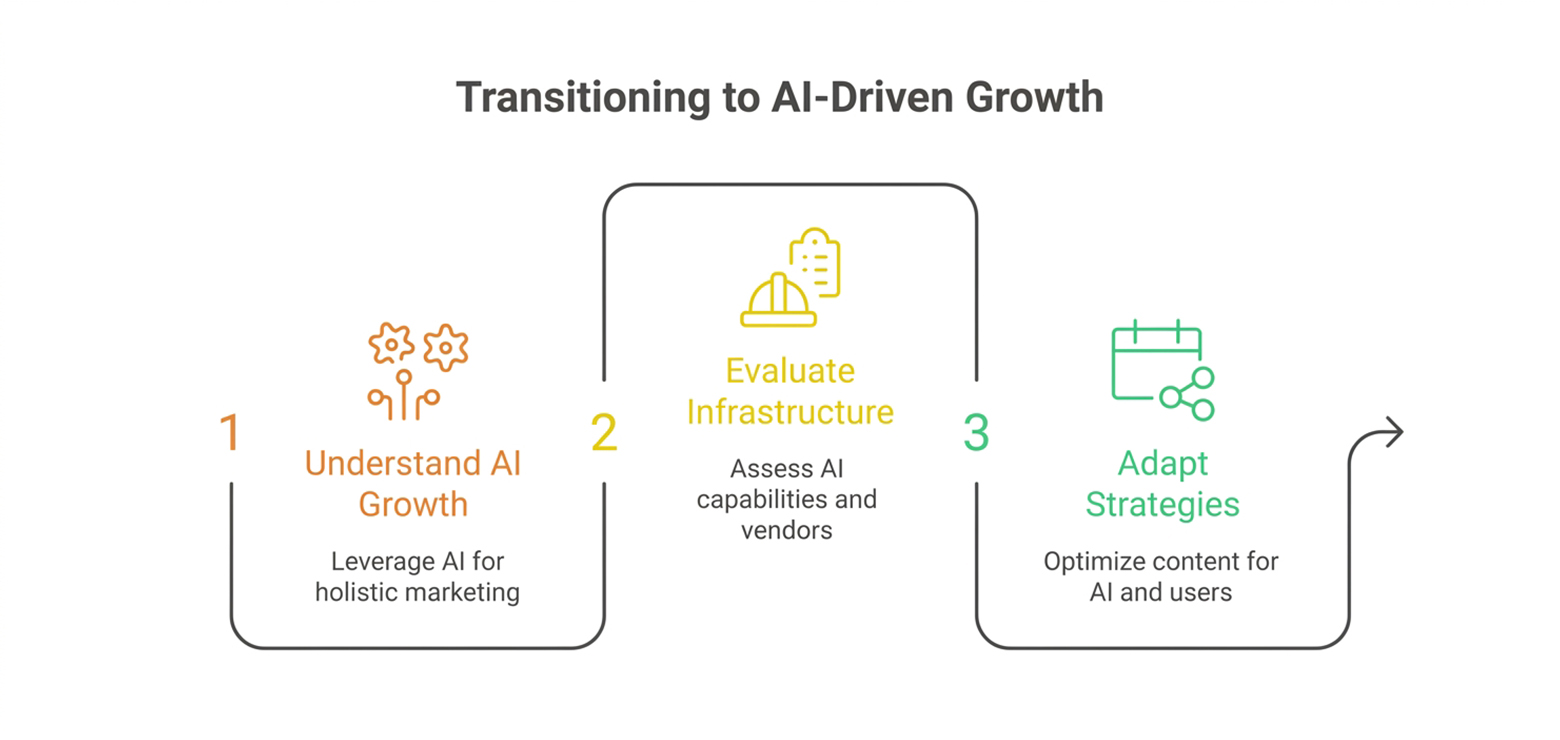
Single-channel SEO isn’t going to recover its old economics, because the thing that changed isn’t a Google update; it’s where a buyer’s attention lives now, and that shift is structural in exactly the way the data above shows. The companies pulling ahead in every category aren’t the ones with the biggest content budget. They’re the ones that rebuilt the infrastructure before their competitors admitted the old model was already gone.
Book an audit call enterprise brands use to find their 3–5 revenue leaks, and see exactly where a single-channel retainer is quietly costing more than it’s earning.
Frequently Asked Questions
Have Questions About Our Marketing Services? We Have Answers!
Is SEO dead because of Google's AI Overviews?
No, but single-channel keyword SEO is structurally weakened, not temporarily disrupted. Pew Research found users click traditional results in just 8% of visits where an AI Overview appears, versus 15% where it doesn’t. A randomized field experiment confirmed the effect is causal, not coincidental, showing a 38% drop in organic clicks with no offsetting gain in user satisfaction. SEO still matters; it just no longer works alone.
What's the difference between SEO, AEO, and GEO? Do I need all three?
SEO earns rankings and clicks. AEO (Answer Engine Optimization) and GEO (Generative Engine Optimization) earn citations inside AI-generated answers on ChatGPT, Perplexity, and Google AI Overviews, where there’s often no click at all. AEO/GEO don’t replace SEO, they build on the same organic authority foundation, which is why splitting them across two uncoordinated vendors duplicates effort instead of compounding it.
How much should a $5M–$10M company budget for an AI growth engine or AI SEO partner?
Most mid-market engagements run $2,500 to $10,000 a month, with full-scope enterprise programs scaling higher depending on site size and technical complexity. Pricing below roughly $1,000–$2,500 a month is a reliable warning sign of thin, templated, largely automated work rather than real strategic capacity. At the $5M–$10M revenue band, budget toward the middle of that range, not the floor.
Can an agency guarantee my brand will show up in ChatGPT, Perplexity, or Google AI Overviews?
No, and any agency that promises guaranteed placement is telling you it doesn’t understand how these systems work. AI-generated answers are probabilistic; they shift based on query phrasing, user context, model version, and retrieval conditions at the moment of the query. A credible partner commits to measurable citation-rate improvement over time, not a guaranteed slot.