

Top AI Companies in Anaheim Are Abandoning Single-Channel Agencies for Integrated Growth OS

Thoughts, ideas, and perspectives on design, simplicity, and creative process.

Top AI Companies in Anaheim Are Abandoning Single-Channel Agencies for Integrated Growth OS

High-angle view of a woman seated at a curved wooden desk reviewing metrics on a yellow desktop computer while a male colleague in a blazer stands nearby pointing at the screen, representing an integrated Growth OS analysis for AI companies in Anaheim

Gartner’s 2026 CMO Spend Survey revealed that an average of 15.3% of marketing budgets are being spent on AI programs, but the survey, which polled 401 CMOs and senior marketing leaders (the vast majority of whom were from companies with revenues exceeding $1 billion), identified only 30% as being AI-ready or possessing full AI maturity. 70% believe that becoming an AI leader is an essential objective to achieve by 2026. Those two numbers make for a pretty good read, and the slow adoption of AI isn’t the story. It’s because the investment is going faster than the infrastructure it’s running on, and a company can invest 15% of its marketing budget in AI tools installed on five different vendors and still fall short of a competitor who doesn’t spend as much, but spends it more efficiently.

The divide between AI spending and AI-ready infrastructure is where Orange County’s tech sector is today. This is Chimera’s home market, and it’s not a sleepy one: Local economists estimate that the tech incubators in Orange County alone received more than $11 billion in investment during 2026, and Y Combinator’s own batch data shows Southern California representation is strongest across the very areas the region is known for: AI and defense-tech. The City of Anaheim also has its own real growing technology operators such as
Anaheim-based Parsec Automation, a manufacturing-software firm, that is now well known for its contribution to the Industry 4.0 drive for data infrastructure in the factory. The AI functionality in this area is authentic. It remains unclear if the marketing ecosystem for the companies has stayed up to date, and a region-by-region analysis showed that 70% of SoCal tech startups are already testing AI, while a much smaller percentage claimed they had achieved something measurable. It’s not an AI problem. That’s an infrastructure issue, and it’s the same issue that Gartner is talking about at the enterprise level across the country.

What the Enterprise Data Actually Shows

Three separate pieces of Gartner’s own 2026 research, read together, describe a company in the middle of restructuring itself around AI, not smoothly, and not by simply adding tools.

Budgets are flat while priorities have to shift underneath them

In 2026, marketing budgets increased by just 0.1 percentage point, to 7.8% of company revenue, up from 7.7% the year before, yet 56% of CMOs state their organisation doesn’t have the funds required to execute its 2026 approach, while 54% acknowledge that it lacks resources at all. That’s not a company that’s able to afford to pay five single-channel vendors at a time when they are also paying for an artificial intelligence transformation. A unification must be accomplished.

Consolidation pressure is already showing up in how the stack gets audited

In a separate survey of 413 marketing technology leaders, completed mid-2025, 81% were either already piloting or had deployed AI agents within their own organization, and Gartner’s own reporting on the trend highlights the fact that technology leaders are actively considering consolidating their stacks in particular because of AI agents and automation, rather than adding another point solution to the stack.

Where the budget does move, it's moving toward channels an AI system can actually act on

Gartner’s 2026 CMO Spend Survey also revealed that digital channels now dominate marketing media spending at over two-thirds of total marketing spend, up 18% from the previous year, with AI-powered personalization being one of the main drivers for the increased investment from the CMO’s perspective. A single-purpose SEO or PPC vendor’s channel is not the same as an integrated system, as the personalized experience Gartner talks about needs data sharing across channels, not just remaining in one.

And the "just automate it" story is more complicated than the AI headlines suggest

As AI becomes more and more involved in marketing execution, so has the cost of labor, as it increased from 21.9% of marketing spend to 24.5% in the same Gartner dataset. AI doesn’t replace people; it makes them more valuable because they are skilled enough to lead the AI. The opposite side of Forrester’s forecast for 2026 is a bit more specific when it comes to what’s most likely to be lost in the agencies: He predicts that around 15% of agency positions will be cut in that year, but that the roles most likely to go are the clerical, sales, and research jobs. It’s the people who are doing the commodity executions that’re getting automated out. The more valuable, not less, are the people doing integration and judgment.
All of this is not an excuse that artificial intelligence is not mandatory. It’s an argument that the operating model supporting the AI spend is actually the limiting factor, and one that Forrester has been espousing about B2B revenue engines for years: Forrester’s own research revealed that organizations that integrate marketing, sales, and customer functions into one, coordinated operating model boast 19% faster growth and 15% higher profitability than those that do not. It’s not a discovery from the age of AI (which has come before this one), which is why it’s worth quoting. The idea of keeping the UI and UX of an app together versus separating it into two different applications is not a new AI concept. The price of ignoring AI has gone up.

What "Growth OS" Actually Means, Operationally

It’s not a rebrand of the AI growth engine for the sake of a fresh term. It’s not a rebrand of the AI growth engine for a new term; it’s “growth OS”. It’s the more fitting title of what the Gartner data above refers to: One operating system with AI-powered organic authority, answer-engine signals, and conversion architecture in one accountability system, rather than a myriad of point solutions optimizing their own metrics.

The difference is that the term “single-channel agency” isn’t exactly about channels; it’s about the number of separated systems of record. A company that uses a different vendor for SEO, another for paid media, and another for email is not operating three channels. It’s running three different data models which don’t communicate at all, just what Gartner’s CMOs these days are being ordered to remove from their budgets. But the only way the AI-driven personalization Gartner’s data suggests that CMOs chasing is actually possible at the budget levels most $5M–$10M companies are operating at is by having a unified system, one that will collapse the data from a lead’s activity across all channels into a model.

The reasons for the demise of the old model are explained in our complementary article about why single-channel SEO retainers are structurally dying, which we wrote in more detail: This song is about what the numbers say should be in its place.

Why This Matters Specifically for Orange County's Growth-Stage Companies

One thing holds for any Anaheim or greater Orange County company considering this shift: it’s more likely to be in Gartner’s “growth stage” tech and manufacturing quadrant than the average company in the country, and that’s because those companies have less budget slack to operate a disparate stack as they invest in their AI transformation.

Don’t get me wrong, but that’s exactly the state of affairs in the region given the amount of piloting going on and comparatively little measurable ROI, but this imbalance is far more costly at a $5M–$10M revenue level, than at a $1B level, because no budget line’s deep enough to support an entire stack of underperforming vendors while waiting for AI initiatives to grow organically. It’s not the companies that are simply piling on an AI tool in an otherwise-chaotic stack that are most likely to close that divide. They’re the ones that are merging their systems into a single, responsible system before their peers ever do, because it’s the same structural reason for the majority of $5M–$10M businesses to hit a wall with marketing that works well on paper, but never on the bottom line.

How to Tell If You're Actually Running a Growth OS, or Just a Bigger Stack

An integrated AI layer on an already disjointed vendor relationship does not result in a Growth OS. It creates a disjointed vendor relationship atop an AI layer, which is arguably worse, as now more systems aren’t talking to one another, rather than fewer.

The truthful test, as outlined in greater detail elsewhere, is the questions that distinguish an AI-native capability from a repackaged version of the same thing, the math behind a retainer that reveals a CMO for one channel, not the whole channel, and the organization choice of whether to hire an agency or a fractional CMO or a in-house hire that is responsible for the entire system and not just a piece of it. If the vendor without a reliable answer to those questions sells the “Growth OS” language without the operating model that will make it count, it’s doing what Gartner’s data cautions against: Buying AI without an operating model.

The Region Is Growing Faster Than Most Companies' Marketing Infrastructure
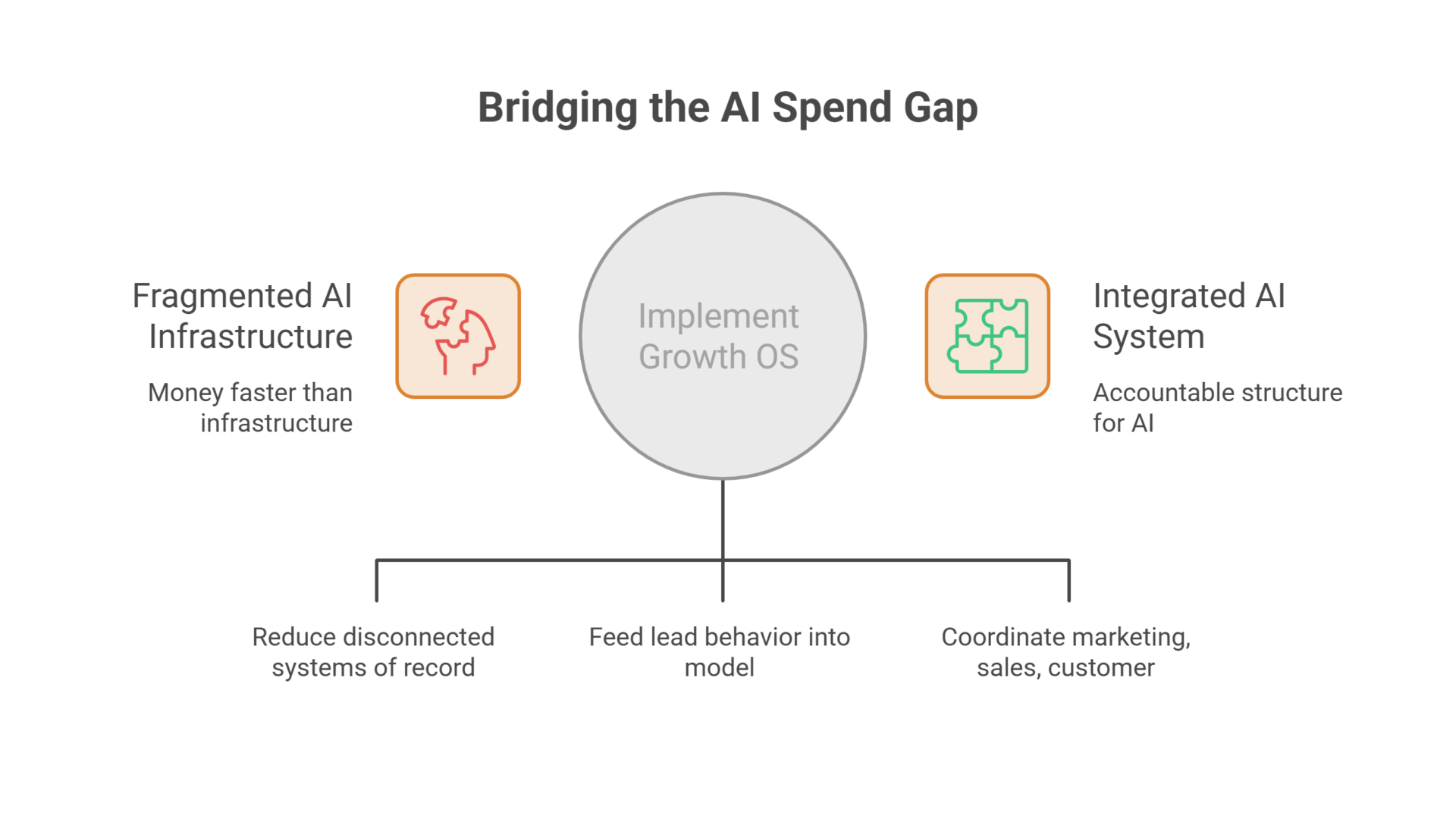
a comprehensive visual interpretation about synergy followed by top AI companies in Anaheim that have quit sigle channel companies
Orange County’s technology base is real, and it’s accelerating. The marketing infrastructure most companies in it are running was mostly built for a slower, single-channel era, and the enterprise data above says that gap gets more expensive every quarter it stays open, not less.

Book a growth infrastructure audit with Chimera and find out exactly where your current stack is still running single-channel logic on an integrated-era budget.

Frequently Asked Questions

Have Questions About Our Marketing Services? We Have Answers!

No, a martech stack is a collection of tools; a Growth OS is one accountable system where SEO, AEO, paid, and retention data feed a single model. Gartner’s own 2026 data shows CMOs actively consolidating stacks around AI agents specifically because fragmented tools can’t share the data AI-driven personalization requires.

Because smaller companies have less budget slack to run a fragmented stack while an AI initiative matures. Gartner’s enterprise survey shows even $1B+ companies feel this budget pressure; at $5M–$10M revenue, the same fragmentation costs a proportionally larger share of the marketing budget.

Forrester’s own research on B2B revenue engines found that companies successfully aligning marketing, sales, and customer functions report 19% faster growth and 15% greater profitability than those that don’t, a finding that predates the current AI wave and reflects the underlying value of integration itself.

No, Forrester’s 2026 prediction is that roughly 15% of agency jobs will be eliminated this year, concentrated in clerical, research, and execution-layer roles, while senior strategy and integration judgment become more valuable, not less. The shift is in what agencies are paid for, not whether they’re needed.


Check whether the agency has achieved AI visibility for its own brand before selling the methodology to you; practitioners who can’t get themselves cited in AI answers haven’t proven the approach works. Combine that with the checks in our retainer audit and AI visibility vetting guide: named senior strategist, work samples with proprietary data, and reporting tied to pipeline, not mention counts.

To Get Started, Simply Fill Out
The Form Below!