

Within the past year and a half, each agency in the country made an “AI Visibility” slide. Most of them added the slide first, and then added the ability. It’s not cynicism, it’s math: Generative engine optimization is still a fairly new discipline, just two years old, so the agencies who say they’ve been working with “AI SEO for five years” are at best rounders.
It’s intended for someone who has already heard that buyers are now beginning their research on platforms like Perplexity, ChatGPT, and Google’s AI Overviews, and is now faced with an agency presentation, asking himself whether it’s the real thing or a rebranded SEO service with new slide designs. The 12 questions below are the ones that make the difference between the two, and are not answerable with a line from a sales deck.
1. How exactly do you define and measure "AI visibility", and on which platforms?
The direct answer: if the agency can’t name a metric, a measurement cadence, and a specific set of platforms, they don’t have a methodology; they have a buzzword.
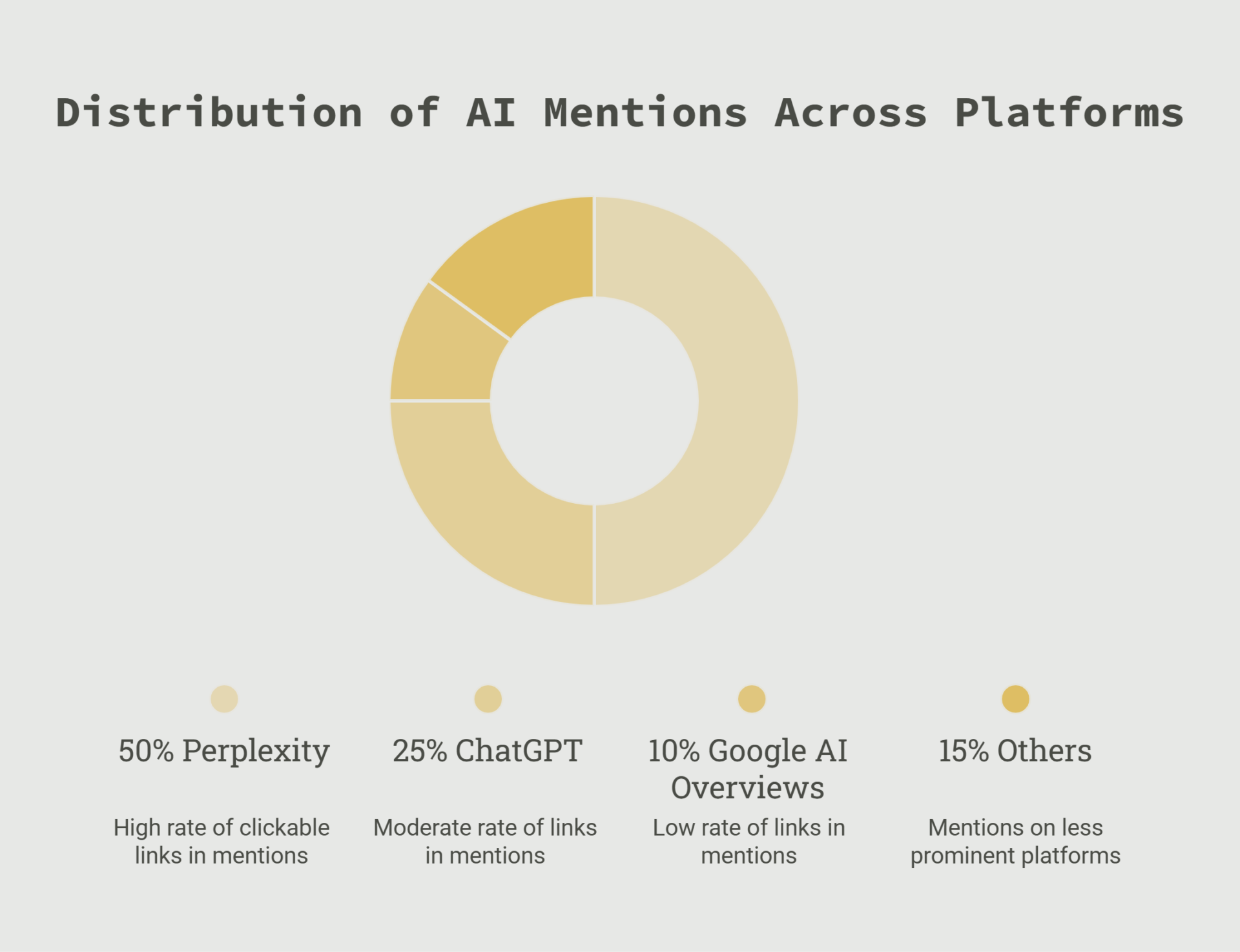
While the term “AI visibility” is thrown around as a general term, the engines act very differently, and a given score would likely be quite meaningless without an engine name. Perplexity includes a clickable link to over 50% of its brand mentions, ChatGPT provides a link back in about 25% of its mentions, and Google’s AI Overviews do so in approximately 10% of their mentions. If anyone is saying that they have been seen in the mind of a buyer without stating the specific vehicle, mentioning the brand, or the specific number of ways in which the brand was mentioned, then they are not reporting visibility; they are reporting activity. Ask them about their unit of measurement, Share of Answer, frequency, linked-citation rate, and sentiment, and ask them to provide you with last month’s “unit of measurement” for an existing client. If they are not specific, that’s your answer.
2. What does your AI visibility audit actually check, beyond typing our name into ChatGPT?
The direct answer: a real audit tests structural signals, not just brand recall.
There are plenty of “audits” in which someone types “who are the best [category] companies” into ChatGPT and screenshots what it says. Many “audits” involve putting the phrase “who are the best [category] companies” into ChatGPT and then screengrabbing the results. This will indicate to you if you are being cited. It doesn’t tell you why, and that’s not enough to tell you what to fix. A defensible audit takes a step-by-step look at what we build our engagements around: 5 signals that make or break whether or not an LLM will mention a brand: entity clarity, organic authority, content architecture, technical infrastructure, and offsite mentions. Request the agency to provide their signals’ names. If they can’t create smaller pieces of the audit that can be diagnosed and fixed, then they are not selling you a strategy; they are selling you a screenshot.
3. Are you building AI citation on top of real organic authority, or on nothing?
The direct answer: GEO without an SEO foundation is decoration in an empty room.
The most common and costly misconception in the category. The indexed web that Google indexes is the same web that LLM’s are trained on and their source for information, which means if Google doesn’t have a brand as an authority in a topic, there is nothing for an LLM to have a reliable source for information, despite the amount of “AI content” placed on top. A $10M brand can rank on page one of Google, but it still won’t be structurally visible on Perplexity, as the two systems don’t place equal importance on authority; neither of these two does give a brand with no organic search foundation whatsoever any benefit whatsoever. When an agency offers you a GEO engagement without asking you what your domain authority is, what the depth of your content is, and what type of backlinks you have, they are offering to build the second story before the first story is finished.
4. How will you resolve our brand as a single, citable entity across schema and the web?
The direct answer: if a model can’t confidently tell that “your brand,” “your brand LLC,” and “yourdomain.com” are the same thing, it won’t risk citing any of them.
This is known as entity resolution, and is the first gate that any LLM will have to pass through before naming a business in an answer. The lack of consistency in your brand name across your website, directories, LinkedIn, and press mentions not only looks dirty, but it also makes it very difficult for the model to combine all of those signals into a solid brand. Inquire directly about their plan to audit and standardize Organization, LocalBusiness, and sameAs schema on your properties, and their approach to reinforcing your visual and naming identity, rather than your identity being split and disoriented across all the models on which it could be seen. If you have an agency that’s trying to do this as a one-time technical endeavor instead of a consistency discipline, then you’re overlooking the issue.
5. What's your position on llms.txt, and how do you decide where engineering hours actually go?
The direct answer: this is the single best trap question in the entire category, because the honest answer is “it’s mostly unproven, and we don’t lead with it.”
Several agencies throw llms.txt into the list of required deliverables. One in 10 domains uses one, but during a 90-day study of domains loggers and crawlers visited, only one of the 50 most cited AI domains had an llms.txt file, and only 1/62,000 of the more than 62,000 recorded AI bot visits to a test site requested the file. That’s not bad, but it means that a company that opens up the pitch with “we’ll set up your llms.txt” is opening with a line item that’s less proven and more cost-effective, than the technical stuff that actually moves the needle when it comes to citation frequency, clean server-side rendering, real schema, crawlable architecture, and the site structure that tells crawlers whether they can even reach your content. Ask which is their top priority, llms.txt or others. If it’s close to the top, that’s a tell.
6. How do you tie AI citations to pipeline and revenue, not just mention counts?
The direct answer: a mention count is a vanity metric until someone connects it to a lead.
If no one has ever asked a query that resulted in a citation, then there was no business value that was added, even if the agency issued 40 citations this quarter. What you really want to be tracking is the appearance of citations when you’ve got commercial-intent queries, such as: “Who should I hire for X?”. “Best [category] for a company our size?”. Not just brand-awareness queries, which don’t influence a buying decision. Inquire about how citation data is utilized in your CRM or attribution model, and how this dovetails into a lead generation system that qualifies and scores leads for your sales team before passing it on to them, not another dashboard that no one in revenue operations ever visits. If they start their talking points with the number of mentions of the article, and only talk about pipeline later, you’re getting a vanity number.
7. Who on your team owns this account, and what's their actual GEO/AEO background?
The direct answer: if the person running your account learned GEO eight months ago on the job, you’re the training data.
It’s a valid question, and it’s a very new category; for most “senior AI SEO strategists,” this is only a job for less than two years. While that doesn’t automatically mean disqualification, it does mean you should expect to pay and how much supervision the work requires. It also brings up the question that every $5M-$10M company has to ask at some point: does this sit on top of and as an add-on to the existing SEO account manager, or is it its own thing? It is the same structural dilemma that exists when deciding whether to hire a marketing agency, a fractional CMO, or an in-house hire: accountabilities and budgets slip away unspoken.
8. Walk me through your content production process; where does the proprietary data come from?
The direct answer: if every answer could have been written about any company in your category, an LLM will summarize it and cite someone else.
This is the way that the Sycophantic SEO Trap works: content designed to check off every box in the SEO checklist and would never get mentioned by a model because there is no named client outcome, no proprietary data point, and no position that could not be offered by a competitor’s blog. Inquire directly from the agency: How many of the pieces they’ll publish for you will contain a real data point, benchmark, or client result unique to your business? If you respond “we’ll research the keyword and create a short around it,” you are asking for “noise,” and Google’s Helpful Content systems and LLM retrieval have come to increasingly value this kind of noise.
9. What's your off-site citation strategy, and which platforms are you actually prioritizing for us?
The direct answer: the engines don’t source citations the same way, so “get us mentioned on Reddit” is not a strategy; it’s a guess.
The thing is, most pitches take the wrong approach here. Both Reddit and Quora threads have real weight inside Google’s AI Overviews (7% and 4% respectively), but neither feature makes the top 10 list of sources found inside ChatGPT or Perplexity, in which sources are weighted differently. What that means is that if you have a blanket “we’ll seed Reddit mentions” strategy that’s geared for forum volume, then you’re optimizing for one engine and assuming it works for all three. If you’re looking for a technically sound agency, you should be able to ask them which channel off-site they’re going to prioritize and where, like Reddit, industry blog posts, or LinkedIn posts by mentioned players in your space, or G2/Clutch-style listings.
10. What's the pricing model, and what should a $5M–$10M business actually expect to pay?
The direct answer: know the market range before the call, or you can’t tell a fair quote from a lowball or a markup.
Retainer pricing for GEO/AEO work in 2026 generally runs from about $3,000 to $20,000 a month, with most mid-market B2B engagements landing between $5,000 and $10,000, and standalone audits priced between $1,500 and $5,000. Below that range, you’re often paying $29–$489 a month for a self-serve monitoring dashboard rebranded as a service, useful for tracking, but not a substitute for the structural work that earns a citation in the first place. If a quote comes in dramatically under $2,500 a month for full-service work, ask what’s actually excluded. If it comes in at enterprise pricing without enterprise scope, ask why. This is exactly the kind of engagement we scope through AI SEO automation built around measurable deliverables rather than a flat package, you should be able to see the line items, not just the invoice.
Red-engage
Humanswith
11. Can you show a live, reproducible example of a brand you moved from absent to cited?
The direct answer: one screenshot is an anecdote. A pattern across multiple query phrasings is proof.
This category is particularly easy to fake, as there is no public leaderboard to monitor AI citation. The category is also very easy to fake, since there is no public leaderboard to keep an eye on AI citation. Educate them that, to test the query variations they tested, rather than “best [category] company”, the five or six ways a real buyer would word it, and to see if the citation remained consistent over weeks, and not just the one time they found it before they called in to sell. The actual proof standard is consistency across query fan-out. One time each win is displayed is that the platform was lucky that day. This doesn’t show that the agency constructed something enduring.
12. How does this integrate with our paid media, retention, and existing growth stack?
The direct answer: AI visibility bolted onto a fragmented stack just becomes one more disconnected vendor with one more disconnected number.
The question that really safeguards the investment. The problem is that most companies within the $5M–$10M range become stagnant because no one is responsible for how the three numbers (SEO, paid, and GEO) compound. The issue is that most companies in the $5M–$10M range get stuck because no one is responsible for how the three numbers (SEO, paid, GEO) add up to revenue. If an AI visibility engagement is not aligned with your paid spend and content calendar, and retention program, it’s a fourth silo, not a fix. Speak with your agency directly about their reporting in relation to the entirety of your funnel, or if one team of vendors running one system is better suited to your needs than five vendors with their own dashboard.
Conclusion: The Question Behind All Twelve
None of these questions are designed to be unanswerable. A genuine AI visibility partner will answer most of them in the first thirty minutes, unprompted, because the answers are the actual sales pitch. An agency that reroutes every question back to “we’ll build a custom plan for you” hasn’t answered the first one either.
If you want a straight answer to all twelve for your own business before you sign anything, schedule an AI Visibility Audit with Chimera; you’ll see exactly which of the five signals you’re already winning on, which ones are costing you citations right now, and what it would actually take to fix them.