

Why "Broken Funnel" Undersells What's Actually Happening
What Changed in Google Tag Manager's 2026 Update
Google Consent Mode v2, The Regulatory Driver
Why GTM Updates Break Tracking Without Warning
Server-Side vs. Client-Side Tagging
What This Actually Costs at the $10M–$50M Revenue Level
How to Fix Broken Funnels
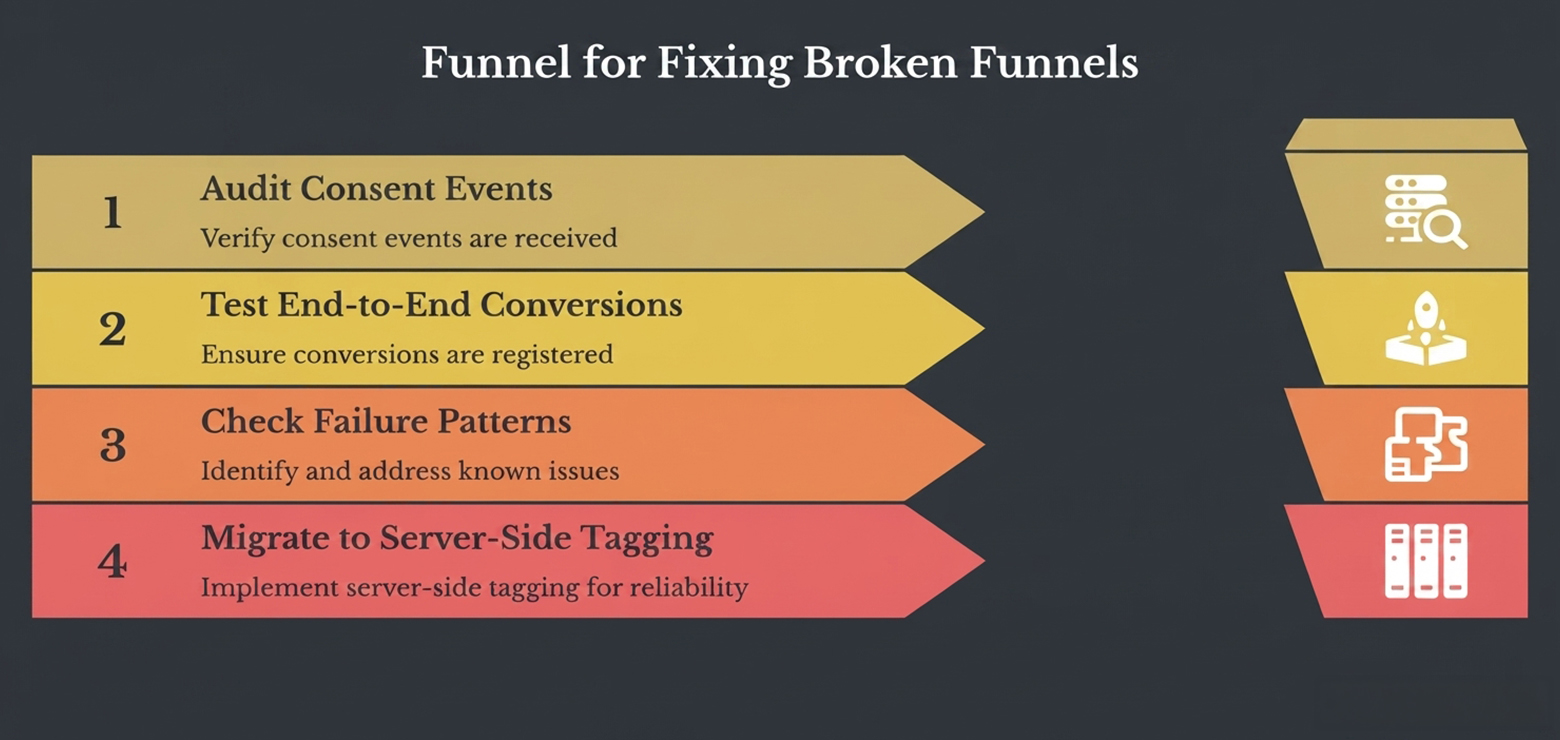
- Audit the consent-to-tag pipeline directly, not just the banner. Confirm your CMP is firing consent_update events that GTM actually receives, a green Tag Assistant status does not confirm this.
- Test a real consent acceptance end-to-end and verify Google Ads and GA4 conversions still register afterward, not just that the tag fired.
- Check for the seven known failure patterns, missing defaults, bypassed custom HTML tags, missing redaction parameters, and over-restricted regional defaults, against your live container, not documentation of how it was supposed to be configured.
- Migrate to server-side tagging if your account carries enough volume that a repeat of this failure mode would be materially expensive, it doesn’t eliminate the risk, but it puts a single, auditable checkpoint between your site and Google’s infrastructure.
This is precisely the kind of technical infrastructure audit our web development team runs before touching any conversion campaign, because no amount of creative or media optimization matters if the system reporting on it is quietly lying
First-Party Data Strategy, The Long-Term Fix
The problem is that consent-driven tag failures are a symptom that there is a deeper dependency: “Google’s tag infrastructure as the only record of what happened on their site. The structural solution is a first-party data strategy over consented data directly collected into your own marketing and CRM systems, rather than any one ad platform’s cookies and/or tags. It’s also the only method that will remain after Google’s next update, as it’s not the qualified pipeline that’s meant to be in someone else’s measurement system; it’s the account of record for the revenue your business actually owns.
The Blind Spot Behind the Blind Spot
If the underlying conversion tracking is running without them knowing, there’s no way to determine which channel is generating revenue- organic, paid, or AI-generated citation- leaving every subsequent optimization choice based on muddled data. As an AI SEO agency in Anaheim, CA, and as one of the top AI SEO companies in California (and USA) with enterprise-level clients, we don’t think of tag infrastructure as a mutually exclusive path to growth, which is why a client would need to choose which SEO agency in California they would want to work with if they were considering tag infrastructure as part of their growth strategy, rather than optimizing around it.
Frequently Asked Questions
Have Questions About Our Marketing Services? We Have Answers!
How do I know if my Consent Mode setup is actually working, not just installed?
A green status in Tag Assistant only confirms the tag fired; it doesn’t confirm the correct consent signal reached Google. Test a real consent acceptance end-to-end and verify the resulting conversion actually appears in Google Ads, not just in your own dataLayer.
Is Google Consent Mode v2 required if my business is based in the US?
Yes, if you serve any EEA or UK traffic and use Google’s advertising features, the requirement applies to the traffic’s location, not the advertiser’s. A US-based enterprise account with any European visitors is in scope.
Should I hire a GTM implementation expert, or can this be fixed internally?
An internal team can usually implement the basic parameters correctly. What internal teams most often miss are the seven silent-failure patterns: missing redaction fields and overly broad regional defaults, which require a dedicated audit against a live, working container rather than documentation review.
Can Google Analytics or Search Console show AI visibility attribution?
Not directly. Neither has been designed with the ability to record if an AI engine used a page in an answer that didn’t lead to a click. What they can do is to check the secondary signal: They can check the movement of their search volume in the weeks after the AI citation increase, which is a more reliable downstream signal than the movement of AI referral traffic, than the movement of their AI referral traffic.
Is a correlation between brand mentions and AI visibility the same as proof that mentions caused the increase?
Absolutely not, and that’s the word of the researchers behind the biggest public studies here. The statistical correlation between mentions and AI visibility, as shown by both Ahrefs’ 75,000-brand analysis and BrandMentions’ 410,000-mention study, is both high and positive. Ahrefs states that mentions correlate with AI visibility, while BrandMentions explicitly states that it is a correlation and not a causal relationship.
What does an AI visibility audit from The Chimera Marketing include?
The same diagnostic layer as the one used to build the framework above, a brand mention and citation gap analysis on the main AI platforms, and a source-level map of which domain specificities are currently driving brand visibility versus named competitors. It’s available free of charge and without any obligation as the basis for any AI SEO relationship.