Almost half the users searched using traditional results in visits where an AI Overview was displayed, compared to 15% of visitors who did not see the AI Overview. The same pattern was observed in a separate randomized field experiment, in which real users were randomly assigned to either the control group or the treatment group (where an AI Overview was shown), where outbound organic clicks dropped by 38% with no corresponding drop in user satisfaction. That second is the one you want to mull over. Google simply can’t claim this is a shoddy thing around which users will navigate. The click didn’t go to the other agency’s optimization tactic. It ceased to happen intentionally, deliberately, and users weren’t even complaining about it.
This is the fact: a lot of top $5M–$10M companies in Anaheim, CA are still building their marketing budget around a single-channel SEO retainer that was designed for a search engine that no longer works the way it did when the retainer was priced. This piece is about what’s replacing it, why the replacement only makes commercial sense once a company is large enough to feel the compounding cost of staying single-channel, and how to tell an agency that’s actually built for this from one that’s added a slide.
Part I: Why Single-Channel SEO Is Dying
It’s not a Google mood swing that has caused the obsolescence. It’s structural, and it appears at three different locations simultaneously. The click compression is there, and it is getting worse: not temporary. The above Pew and field-experiment results were obtained by very different methods, one observational (real people, real browsing sessions), one a controlled experiment (purely causal separation of cause and correlation). If two independent methods give the same result, it is not noise. That’s a floor.
Keyword rankings at the keyword level no longer forecast revenue as before. The #1 ranking of a commercial-intent keyword used to ensure a guaranteed number of clicks. Nor does it anymore, when an increasing percentage of the same questions now receive answers within an AI Overview or a Perplexity/ChatGPT answer before the organic results are even scrolled to. The keyword agency’s whole business is being slowly eroded from the bottom up, bit by bit, one query type at a time, while the bill for retaining the same agency remains unchanged.
Single-channel agencies have no way to respond, as their entire operating model is the channel. An agency that offers SEO retainers is selling SEO. If the channel is getting smaller, they don’t have another lever to pull; they can only optimize more in a smaller box. That’s the real deal with the structure we created to replace channel-siloed SEO; there’s no way a keyword agency can structurally transition itself into an answer engine, community signal builder, or conversion architect, since it will become a different type of firm. Most won’t. Some will re-invent the same service but give it a new name. Even fewer will rebuild.
That’s the question this poses for a company that is still on the single-channel retainer. If your traffic is really down, how does the analytics dashboard still appear to consistently have organic as the number one source of traffic? Will this AI Overview effect be a quick Google experiment that will be reversed at publisher pressure, or is it a permanent reshuffle? What are the particular words in this business’s portfolio that are under the maximum pressure to be compressed and which are structurally secure?
Part II: The Replacement Model, What an "AI Growth Engine" Actually Is
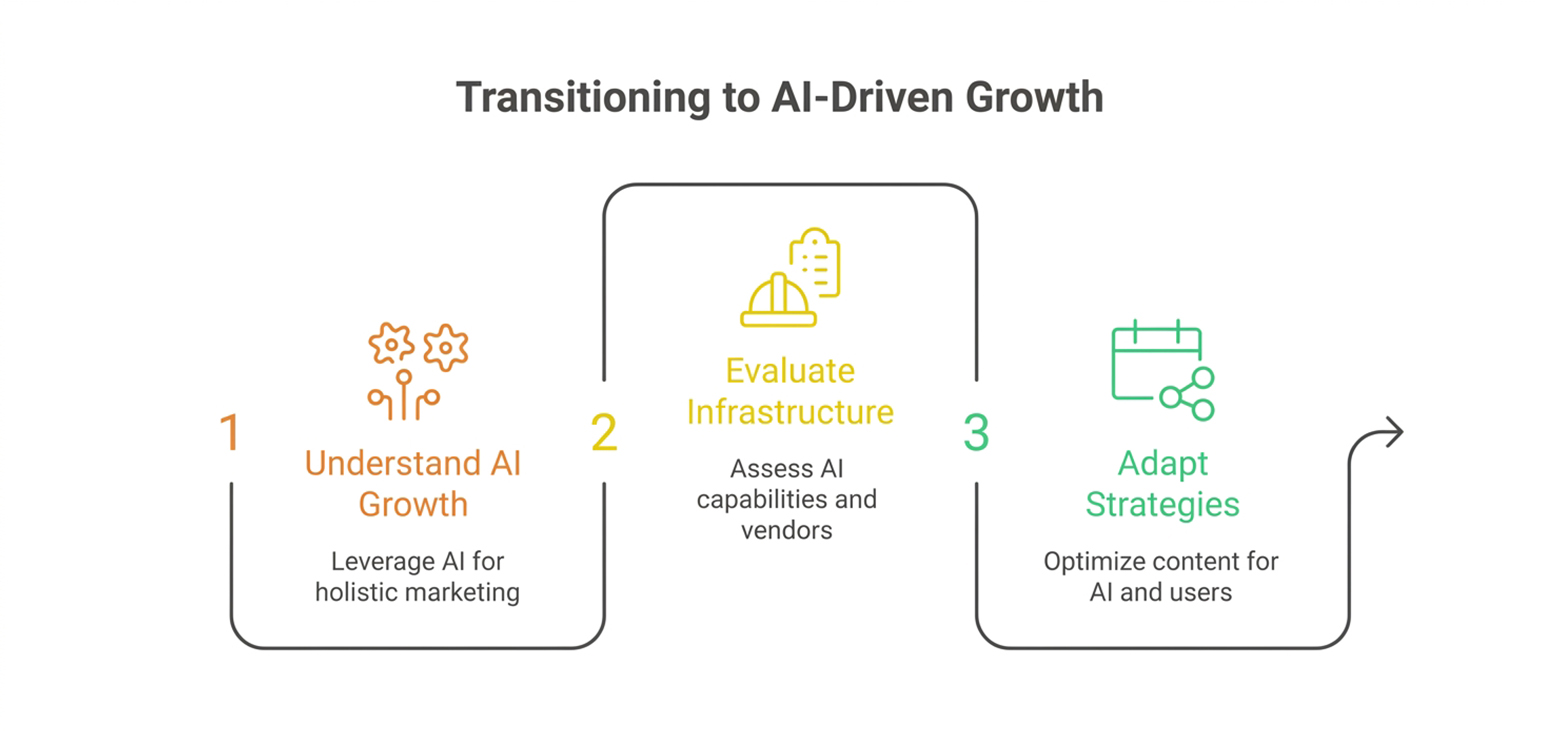
The term “AI growth engine” is bandied around too much in 2026 to want to be cavalier about what it really means operationally, as it does a lot of work in the title of this post. It’s not a website attachment that’s a chatbot. It implies that for Google and answer engines, it is the same signal producing the same rankings, rather than a team competing against each other with half their effort doing the Google thing, and the other half doing the AI thing.
This does not mean that the traditional method of SEO ranking and reporting is not relevant anymore; it does not. Traditional rank-and-report SEO still has a place, albeit not the primary one it had 5 years ago. Organic authority continues to be the source AI engines pull from; if a brand isn’t seen by Google, it is not able to give an LLM anything reliable to cite. The difference is what layer is on top to determine where that authority is spent.
Architecture upstream of the funnel is only part of the model, though. Without a conversion layer, traffic simply means traffic, which doesn’t amount to any revenue; it’s activity. The email and lifecycle infrastructure that turns the initial purchase into a repeat purchase is a part of the same accountable system as the first one is, and not a fourth disconnected vendor, is why the retention layer, which the majority of SEO vendors have no way to control, must be within this accountable system as well. At its core is the technical aspect that will determine if the above is actually feasible: the site itself is built in such a way that it can process all the traffic it receives at a speed and in a clean format that allows the human buyer to navigate it as well as the AI crawler.
So this raises some questions with a company considering the conversion:
What is meant by the term “AI growth engine”? Is it a new tool or a different team organization? What would be the benefit of using one growth infrastructure model versus having five vendors, particularly when a company is already spending money on its own for all three? How exactly is content produced differently when it is created for GEO/AEO and traditional SEO, rather than for one channel and then hoped to perform well in the other?
The truthful response to that final question is the one that no single-channel agency can answer, because it needs to be built into the initial brief, not after the fact, in an attempt to shoehorn content architecture and entity resolution into their existing processes. Before investing a budget in either model, see what a 90-day growth infrastructure audit reveals if you want to know what it will look like when applied to a real business.
Part III: Why This Is Specifically an Enterprise Problem
You can have SEO retainers working for a $500K business for years and not worry about getting one channel to go down because the absolute dollar impact of its disappearance is not that great. A $5M–$10M company can’t: The difference between a channel that’s structurally shrinking and a growth target that isn’t rounds in quarters; it rounds in real people, real quota missed, and at this revenue level, the gap isn’t a rounding error.
This particular size of company has a second pressure that is not obvious. It’s not just that marketing agencies in general aren’t just looking after the interests of their client anymore; they are now owners, resellers, and platform operators with their own business interests woven into the mix, Forrester’s research on Prediction 2026, which reflects his own agency’s evolution, says. A single channel SEO agency in the midst of that larger industry change isn’t nearly as inclined to inform the client the channel’s getting squeezed, because that would be an argument against the retainer. It’s not a conspiracy. It’s a carrot-and-stick approach, and that’s why the diagnosis can’t come from the current cashing vendor.
This brings up the following questions for a company at this particular revenue level:
Where does one channel become more of a hindrance than a help? When a buyer hears an agency say that they have AI, how do they know it’s not a slide they added to their deck? So, what is the real dollar price of remaining single-channel for another year at this rate of growth?The question is: that one is the question to consider before, not after, the next renewal.
Part IV: The Proof Layer, How to Tell a Real AI Growth Engine From a Relabeled Pitch
This is the bit of the argument that all vendors will say applies to them, and hence it’s the part that actually requires a verification standard, not a testimonial.
First, the diagnostic questions that will separate a true AI-native capability from a rebranded content mill, the ones that most companies still don’t know how to answer, and for those who have gotten deep enough into the weeds of vendor evaluation that they are asking for quotes, how to distinguish a true AI-native shop from a content mill that has been rebranded. Here, both of these diagnostics are relevant, as “AI growth engine” is a term any content mill could put on a slide without developing the infrastructure to support it.
It’s not abstract, either: It’s right in front of your eyes with the brands that are already capturing answer-engine visibility, and with the AEO infrastructure that’s taking place behind the scenes, before a user ever hits a session on an analytics dashboard, where most of a buyer’s real vendor research is happening these days. Most of the time, that research phase never takes place in search, either: Reddit and Quora threads have become the source an AI engine trusts enough to quote, a structural argument that a one-channel SEO specialist doesn’t have a framework for discussing, let alone for working against.
The content layer itself has shifted, as well, under the legacies of content production: What if your best content becomes the raw materials for an AI overview? It is also important to be aware of how Google’s own new guidance has already shifted the definition of what “ranking” is: The redefinition is not from an outside disruptor. It is emanating from the platform that the old retainer is designed for. If the company is considering hiring in-house instead, the same process that led them to consider hiring an agency or fractional CMO can be used the same way here.
Questions such as this might arise in the final vendor vetting process:
What is the best way for a purchaser to test the claims made by a vendor around their AI/AEO directly, rather than going on the pitch deck? Who are the current competitors in this same class, and can it be done in a day? What provides a rankings report that 90 days of real growth infrastructure work doesn’t provide, deliverable by deliverable?
Final Thought: The Channel Isn't Coming Back
Single-channel SEO isn’t going to recover its old economics, because the thing that changed isn’t a Google update; it’s where a buyer’s attention lives now, and that shift is structural in exactly the way the data above shows. The companies pulling ahead in every category aren’t the ones with the biggest content budget. They’re the ones that rebuilt the infrastructure before their competitors admitted the old model was already gone.