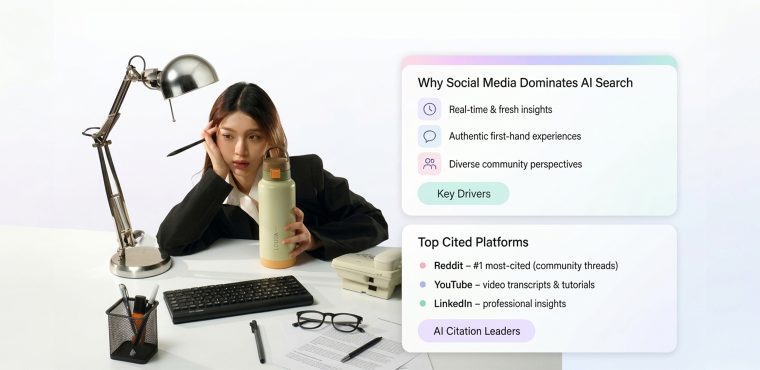
Short answer: because AI answers need corroboration, and social media is where corroboration lives. When someone asks for a recommendation, a brand talking about itself is marketing, but dozens of independent people agreeing, disagreeing, and correcting each other in public is evidence. The data is unambiguous: in a study of 480,000+ prompts across five AI search engines, the four most-cited sites were all social media: YouTube (10.9%), Reddit (8.1%), Facebook (5.9%), and LinkedIn (4.5%), ahead of Wikipedia (1.3%) and Forbes (1.1%). The most-cited sources in AI search aren’t publishers. They’re people.
The Numbers Behind the Headline
Even more starkly, a massive study of more than 680 million citations had an even more surprising finding: About 40 percent of all AI citations came from Reddit alone. According to McKinsey’s findings, the share of brand-owned websites is a mere 5-10% of the sources that AI systems refer to when creating an answer.
Why: Corroboration Beats Claims
The answer is based on the nature of the question (Comparison or Recommendation). A brand talking about its own strengths is not independent evidence; it’s marketing, and AI systems treat it as such when someone is searching for the best option in a category or if it’s worth buying. That question requires some confirmation from somebody who is not looking for the answer, and that’s what Reddit threads, YouTube reviews, Quora answers, and LinkedIn posts already have.
Think about how many people independently post in the same directions and agree and disagree, and correct one another in a single thread on Reddit. The thing is, that’s confirmation in an article more often than not. The best threads follow a basic structure: lengthy comments (several hundred words) that refer to a real product or experience, and they are supported with detail that would be difficult to manufacture as part of a large product line.
This is the reason why the most impressive multiplier in the data is the one for brands with high Reddit content – they received 7 ChatGPT citations, compared to 1.8 for brands with minimal Reddit content, which is a 3.9x multiplier and a 4.1x multiplier for Quora. In fact, AI visibility on social media wasn’t always predicted by backlinks or domain rating; raw brand mentions were far more accurate when it comes to predicting AI visibility on Twitter, YouTube, and other platforms, according to Ahrefs’ study of brand mentions made by 75,000 brands.
The E-E-A-T Explanation: Social Media Is the "E"
Experience
First-hand experience is a YouTube video of someone actually using your product! This Reddit comment is first-hand experience of what owning a car is like for 6 months. Your homepage that tells people about your product isn’t an experience; it’s a statement about experience. AI engines, which have been taught to recognize the two, refer to the real thing. Human forum conversations are more reliable than AI-generated content spam in an era of AI-generated content.
Expertise
The story is best told by LinkedIn. In just a few months, LinkedIn articles advanced from position #11 to #5 on ChatGPT, and are now responsible for 50–66% of LinkedIn’s AI citations. The “named expertise” AI systems are seeking are the very same ones that look for when a question demands authority and not opinion: named professionals who have verifiable careers and have written in their own names.
Authoritativeness
A Stanford study indicated that when multiple contributing authors or discussants are included, the LLM is always inclined to choose that source. When 50 editors edit on Wikipedia, 200 people comment on Reddit, or thousands of people comment on a YouTube video, then it is a sign of comprehensive coverage. Your website will take one attitude. I sense multiple voices that indicate a sense of depth.
Trustworthiness
6 independent users, specific experiences, no financial incentive. That is the way AI systems are seen to be citing more, although no one provider has yet stated exactly why. Lack of incentive is the trust signal.
Why Each Platform Wins Differently
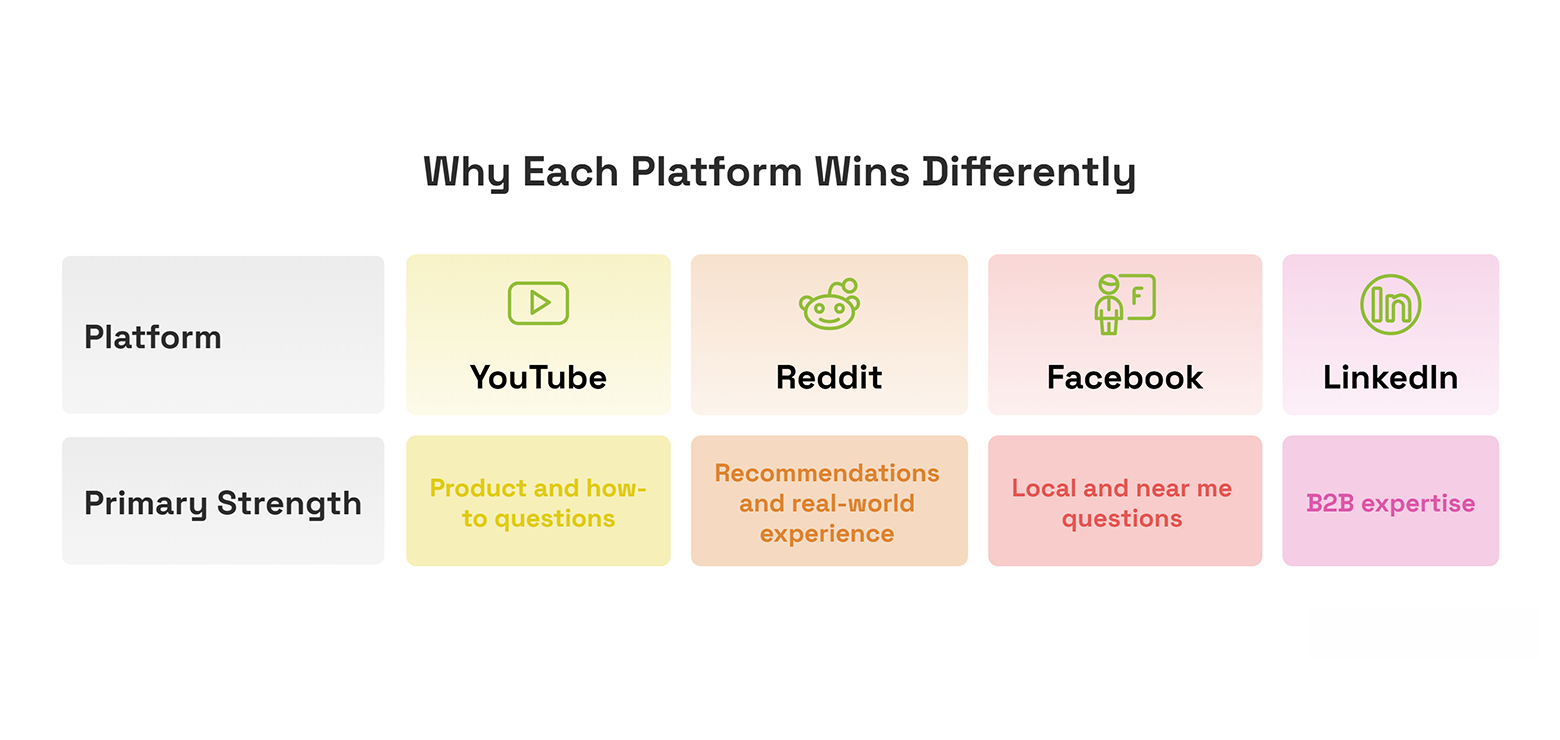
YouTube leads on product and how-to questions. Video transcripts are dense, specific, and demonstrably experiential; the reviewer shows the thing working, or failing. YouTube overtook Reddit as the most-cited domain in LLM responses in Q1 2026, appearing in roughly 16% of AI-generated answers. Google’s own ecosystem bias helps, but the content format would win on its own merits.
Reddit leads on recommendations and real-world experience. Citations from Reddit in AI-generated overviews grew 450% between March and June 2025, and Perplexity cites Reddit 45% more frequently than other sources, with comments sometimes appearing in answers within 24 hours of being posted. OpenAI’s licensing deal with Reddit in May 2024 gave ChatGPT real-time access; the platform’s data is structurally close to the models.
Facebook leads on local. For “near me” and local-service questions, Facebook’s business pages, local groups, and review data feed Google’s AI heavily, part of why local businesses ignore Facebook at their peril.
LinkedIn leads on B2B expertise. Named professionals, verifiable credentials, long-form articles. When a buyer asks which payroll platform or which agency, the named expert’s post carries more weight than an anonymous listicle.
ChatGPT leans more toward editorial and reference sources in certain contexts, Forbes, TechRadar, Wikipedia, while Google’s AI surfaces lean harder into social. The mix differs by engine; the social tilt is universal.
The Honest Caveats: Shares Move Fast
The Five-Step Playbook: Be Where the Citations Are
The data points to a clear strategy, five channels, each earning a different kind of citation:
- YouTube, show the work. Product demos, walkthroughs, before/after evidence, founder explainers. Transcripts are citable text; the video is the experience. This is the single highest-yield social channel for AI citations.
- Facebook, win local. Complete business pages, local group presence, reviews that name your services and your city. For local businesses, Facebook is a citation source Google’s AI reads directly.
- Named expertise: publish under real names. Your leadership’s bylines, not the company blog’s anonymous voice. LinkedIn articles from your CEO and your specialists, with real credentials, are the B2B citation engine.
- CEO LinkedIn, the authority layer. A founder who writes regularly about their industry becomes a citable entity in their own right. The LinkedIn surge from rank 11 to rank 5 happened because named experts are exactly what AI answers need.
- Reviews as a search channel. Reviews aren’t reputation management anymore; they’re a citation source. Specific, recent, experience-describing reviews across Google, Yelp, and industry platforms are the testimony AI answers quote.
None of this replaces your website. Your site remains the foundation, the entity anchor, the structured data, the booking rail. But the foundation isn’t where the citations are won. The citations are won where people talk about you, and the engine’s job is to listen.
The Reframe
The companies that thrive in AI search are the ones that no longer need to wonder how to get their website cited, but how to get talked about by those engines that trust people! There is a solution to the second question, and it is as old as search: remarkable work, easy description, and appearing where the conversation is already taking place.
Frequently Asked Questions
Have Questions About Our Marketing Services? We Have Answers!
Why does AI cite YouTube more than brand websites?
Video transcripts are dense, specific, first-hand experience, the “E” in E-E-A-T. If a reviewer is showing you a product working (or not), it is evidence; if a brand page is describing their product, it is a claim. AI systems refer to the evidence.
Is Reddit really the most-cited source in AI search?
It is dependent on the study and the date. YouTube was #1 at 10.9%, Reddit at 8.1% (across 480,000+ prompts); Reddit was #1 or #2 everywhere (across 30M citation events); Reddit was ~40% at #1 or #2 (across 680M citations). The consistent result is that social dominates; the order varies across changes to the model and litigation.
Does this mean my website doesn't matter anymore?
No. Brand-owned sites represent 5–10% of AI sources and are the cornerstone on which all other things come together. You define who you are on your site; other people confirm it in their social media. You need both.
Can I just buy my way onto Reddit or YouTube?
That backfires. Half of AI shoppers would be less inclined to trust an assistant after discovering that a suggestion was paid for without their awareness. Half of AI shoppers report being less likely to trust an assistant if they learn a recommendation was paid for without their knowledge. It’s the real user, real experience that is the signal. Sponsored content must be identified, and the weight of the disclosure of sponsorship is quite low.
Which social channel should a local business start with?
Facebook and YouTube. Google’s local AI surfaces right away for Facebook, and YouTube is the only most-cited domain. Include Google reviews as the third leg – these are a citation source as well.