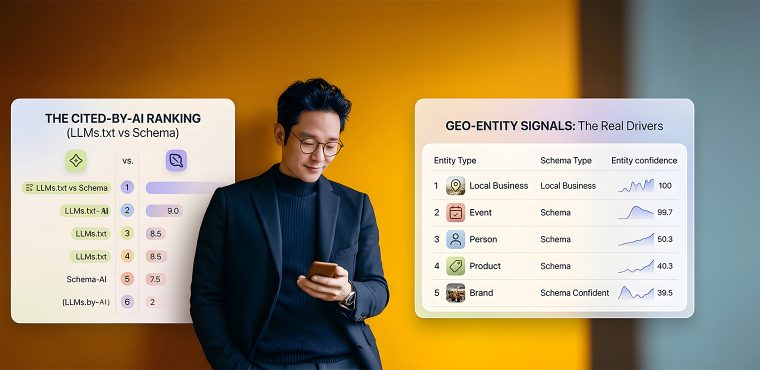
This is not a rank problem. It is a selection problem. Traditional search engines took you to the most relevant page; a new generation of LLM-powered search engines creates a single answer and then selects which sources to trust. The question is no longer “rank highly. It is “chosen as a trusted source by the AI.
The Split That Broke SEO
New independent measurement reveals that just 17% of AI Overview citations are from pages ranking in the top ten organic results on Google (Straight North 2026), a significant decrease from about 76% in mid-2024 (Straight North 2024). The win-to-get-cited game has taken off. Even as SparkToro found that in early 2026, 68% of all US Google searches were never clicked, if an AI Overview does show up, it typically steals about 58% of the click-through rate (Meev). By mid-2026, Google AI Overview coverage was estimated to be between 40-48% of all searches.
The focus here is on the commercial, not the theoretical – the click is no longer the goal. It’s inside the synthesized answer is. Generative Engine Optimization (GEO) is not just a modification of SEO; it’s a new mindset in producing, distributing, and asserting information during the AI era. They have identified this transition in five aspects: Information retrieval, NLP, the RAG architecture, Vector representations, and machine readability. This will be the AI Visibility Framework (AIVI), and we will be returning to this shortly, as it’s the map that will help you know which lever to pull first.
#1. Entity Signals: The Engine of AI Trust
The evidence for entity dominance is the strongest in the field:
- Ahrefs (May 2025) analyzed 75,000 brands and found that web mentions correlate with AI Overview visibility at 0.664, versus backlinks at just 0.218. Brands in the top mention quartile averaged 169 AI Overview mentions versus 14 for the next quartile down, more than a 10x gap. Mentions, not links, move the needle.
- CiteLens (June 2026) benchmarked citations across engines and found that Claude’s citations track brand recognition more than ranking, with 58% of its citations going to sites with a Wikipedia presence. ChatGPT followed neither Google ranking nor brand popularity closely, but entity authority still mattered more than position.
#2. Schema Markup: The Clarifier, Not the Citation Switch
So why does schema rank second? Because it is the highest-leverage clarifier in the stack:
- Entity disambiguation. sameAs links and a complete Organization graph connect your brand to the knowledge bases models trust, reinforcing layer one.
- Passage clarity. Well-structured pages chunk more cleanly during retrieval, so the right passage, not a tangled sidebar, gets pulled into the answer.
- Role signaling. Article, FAQ, Product, and HowTo types tell the model what kind of statement each block is, reducing the chance your pricing page gets quoted as a definition.
#3. llms.txt: Cheap Insurance, Not a Strategy
The adoption story has two halves, and agencies usually tell you only the first:
- Publishers adopted it. Anthropic, Cloudflare, Stripe, Vercel, Perplexity, and others publish llms.txt files, and community directories track many hundreds of implementations.
- Consumers did not. No major AI platform has publicly confirmed that it systematically reads llms.txt in its production retrieval pipeline. Server-log studies have found AI crawlers generally do not even request the file, and Chrome’s Lighthouse audit treats a missing llms.txt as “not applicable,” not a failure.
- The most rigorous measurement available, a Search Engine Land test tracking ten sites for 180 days (ninety days before and after adding the file), found measurable AI-traffic increases on just two of the ten sites (12.5% and 25%), with the other eight showing no significant change.
So why rank it third instead of dismissing it? Because it costs almost nothing. A well-curated llms.txt takes a few hours: a clear summary of what your business does, links to your money pages, pricing, and key documentation, and an optional full-content companion file. If agentic browsing matures, and Chrome’s new Agentic Browsing audit category suggests the industry is preparing for it, you will already be legible. That is insurance, priced correctly. What it is not is a citation strategy. Any agency selling llms.txt as the centerpiece of an AI-visibility program is selling you a smoke detector as a fire department.
The Order of Operations
If you are budgeting for AI visibility this quarter, the sequence is now obvious:
- Entity audit. Is your brand resolvable as an entity? Consistent descriptions, Wikidata presence, earned mentions, reviews. This is the foundation everything else stands on.
- Schema graph. Server-side JSON-LD as a connected entity graph, not scattered markup. Disambiguate the brand, type the content correctly, structure the passages
- . llms.txt. Ship it in an afternoon as insurance, then move on.
- Measure citation share, not rankings. Track how often each engine mentions and cites you, and who it recommends instead.
- That sequence, in that order, is what a serious AI-visibility program looks like. It is also exactly what our free 48-hour AI visibility audit measures: your entity resolution across engines, your schema’s machine readability, and your current citation share against competitors, delivered with the gaps ranked by revenue impact. If you want to know whether the AI trusts your brand yet, this is the fastest way to find out.
Frequently Asked Questions
Have Questions About Our Marketing Services? We Have Answers!
Does llms.txt help you get cited by AI?
While this is not confirmed, it’s also not ruled out that major AI platforms read llms.txt in production retrieval. It is simple to do and could be important as agentic browsing grows as an option, but it will be a plan B, not a plan A.
Does schema markup get you cited by AI?
Not directly. Google says there is no special schema needed for AI Overviews, nor is there any need for pages to be marked up for them. The true power of Schema is eliminating the ambiguity: disambiguate entities, retrieve cleaner passages, and type them correctly for more accurate quoting of your very best content.
What are entity signals in GEO?
The entity signals are the machine-readable facts that appear in a consistent way on your website, on wikis and knowledge bases such as Wikidata, on review sites, directories, and in the news – about your brand. The one thing that determines AI citation best is strong entity signals.
Why doesn't ranking #1 guarantee AI citations?
Because there are more and more systems that are separate for retrieval of AI answers and classic ranking. Just 17% of AI Overview citations are from the top ten organic results, compared to about 76% in mid-2024. Sources are chosen on a basis of trust or entity authority, not position.
What actually gets you cited by AI, in order?
The research and measurement clearly indicate the order: entity signals (brand is a trusted entity), schema markup (machine-readable clarity), and lastly, llms.txt (unproven, cheap insurance). All three are supported by content that the Princeton GEO study revealed could be quoted by the models- that is, specific statistics, named sources, and direct quotations- which the study found could raise the visibility of AI-answer content by up to 40%.