
Enterprise AI search is no longer a Fortune 500 concern. As ChatGPT Enterprise, Microsoft Copilot, Gemini Enterprise, and Perplexity Enterprise become the default research layer for B2B procurement teams heading into 2027, those systems increasingly evaluate mid-market vendors, not just billion-dollar suppliers. Of the four established Orange County agencies working in this space, only one, Directive Consulting, is actually built around B2B discovery specifically. Here’s how that group stacks up, and what it means for a growing OC business trying to get found inside the tools its next enterprise customer is already using.
What does "Enterprise AI Search" Actually Mean?
This is a different scenario than consumer AI search. When a consumer requests ChatGPT for a great restaurant, they expect to receive a swift and certain response. A procurement team that is selecting vendors for Gemini Enterprise or Copilot is conducting due diligence, structured data, entity consistency across business registries/review sites/hubs, and, with increasing frequency, the ability to have the AI system do the due diligence on a vendor’s site to get product and service information. If your agency is geared towards consumers, it does not necessarily mean that it is geared for this.
What Does "Stacking up" for Enterprise AI Search Actually Require?
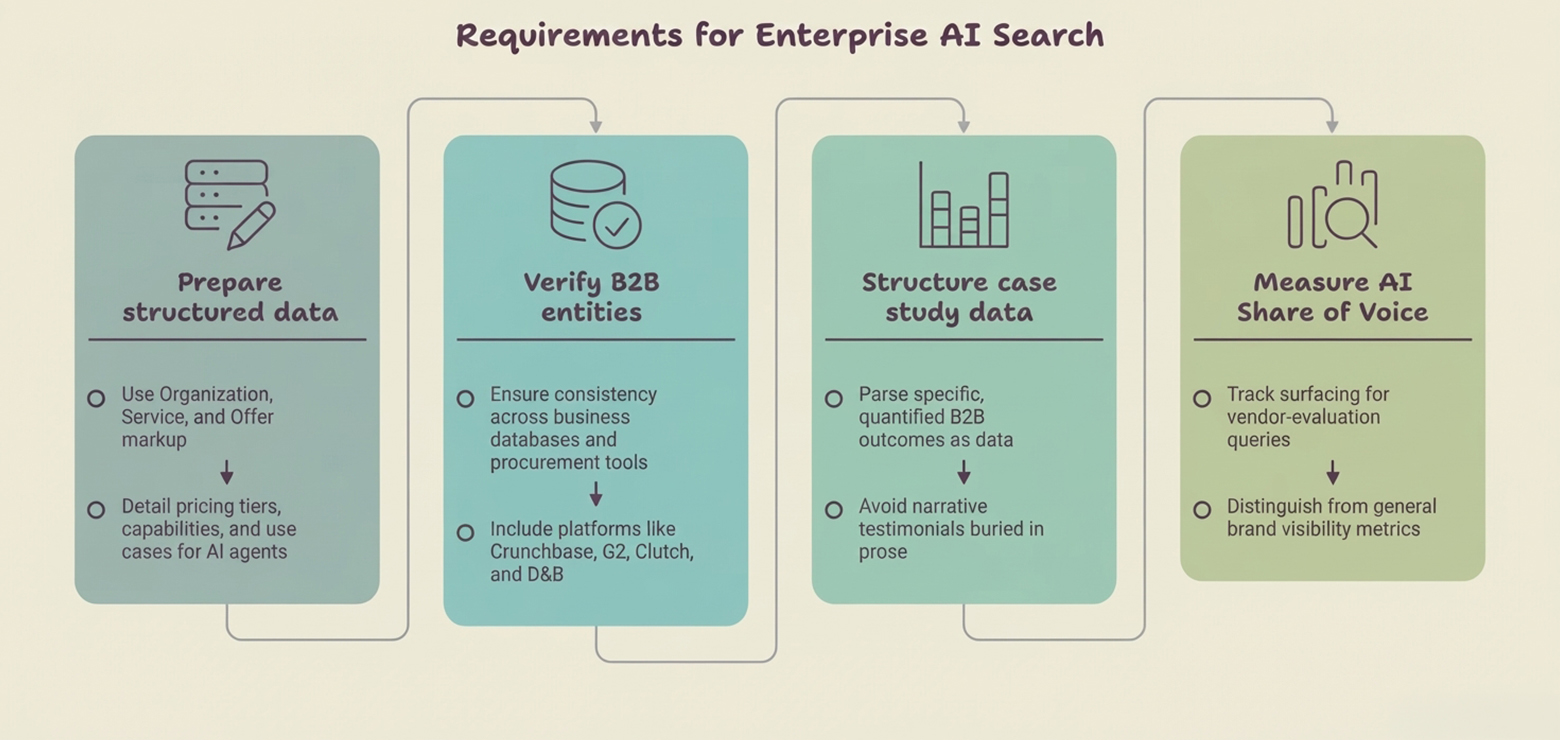
Four things, specifically:
- Structured, machine-readable service and product data, not just blog schema- but Organization, Service, and Offer markup detailed enough for an AI agent to extract pricing tiers, capabilities, and use cases without a human reading the page.
- B2B-grade entity verification presence and consistency across business databases and procurement tools that actually query (Crunchbase, G2, Clutch, D&B), not just consumer review platforms like Yelp.
- Case study depth: an AI agent can parse specific, quantified B2B outcomes structured as data, not narrative testimonials buried in prose.
- Measurement of B2B-specific AI Share of Voice tracks whether a business gets surfaced for vendor-evaluation queries specifically, which is a different metric than general brand visibility.
How does The Chimera Marketing stack up against that standard?
On Structured Data
The Chimera Marketing does not operate generative engine optimization as a loose service line; it’s one out of five explicitly named service layers, with each having its own clearly defined scope (brand and creative, infrastructure, traffic, conversion, retention). The difference between a page that can be easily and cleanly “parsed” by an AI agent and a page that the agent must “interpret.”
On Entity Verification
Chimera has checkable profiles across DesignRush, Crunchbase, BBB, and Trustpilot, the consistency an enterprise AI agent would use to determine if a business is real, current, and what it claims to be. No faith is required there; it’s just a five-minute check against public directories.
On Case Study Depth
On Measurement
How Does This Work for Businesses in Orange County
Where most growing businesses are today: too big to be hidden from enterprise procurement, too small to have an in-house team working on the problem.
The most obvious example is Darbar Foods. It wasn’t a Fortune 500 account; it was a real mid-market B2B distributor who wanted a structured, machine-readable product data set and a transactable system that could manage order placing in a manner similar to procurement processes without it taking a small army of people to process orders by hand. What enterprise AI search needs is discoverability and information that is structured; on the other hand, it needs infrastructure that can actually close and fulfill the transaction, which is solved as one system, not as a marketing engagement handed off afterwards. The demand side of the Royal Tent USA business model is similar: A 16.25X return isn’t generated just by marketing tools, but also by the traffic infrastructure that enables them to qualify and close out traffic AI discovery sends their way.
The Chimera Marketing is not pursuing enterprise business deals. It’s designed for the business that has a huge customer on the horizon, and that customer’s procurement team that’s already using Copilot or Gemini Enterprise to start conducting vendor research, regardless of whether the vendor is prepared or not.
What should change heading into 2027?
Three concrete moves, based on where the data currently points:
- Audit entity consistency across B2B-specific directories now, not just consumer platforms. If Crunchbase, G2, and Clutch don’t match your site’s NAP and service data, an enterprise AI agent doing diligence has a reason to hedge before your competitor’s page ever loads.
- Structure case studies as extractable data, not narrative. A quantified before/after table an AI agent can parse directly outperforms a well-written paragraph it has to interpret.
- Track B2B-specific AI Share of Voice separately from general brand visibility. Ask the AI platforms your buyers’ procurement teams actually use the exact vendor-comparison questions they’d ask, and see who gets named
Frequently Asked Questions
Have Questions About Our Marketing Services? We Have Answers!
What's actually different about "enterprise AI search" versus regular GEO?
The following is a typical example of a person asking a specific question and GEO optimizing it accordingly for the consumer’s benefit. Enterprise AI search is built for someone else to do vendor diligence on your behalf, meaning it must have the depth of structured information, the B2B nature of the data, and have measurable proof that a human reviewer would trust, and not just a confident-sounding citation.
Does a business need to be a large enterprise itself to benefit from this?
No, it’s typically the other way. It’s the largest accounts that are served by the business with the biggest budget who benefit the most, as it is they who will be using enterprise AI procurement tools. It doesn’t have to be enterprise-size, but it does have to be enterprise-legible.
How is this different from a standard AI visibility audit?
The criteria evolve to B2B-specific ‘signals’, entity verification on the business database, not on consumer review platforms; case studies built for extraction, not narrative; and Share of Voice calculated against queries comparing business vendors, not brand mentions.
How should a mid-market OC business start preparing for this shift?
If you ask your real buyers the questions they would ask the vendor to compare, you’ll find out who those vendors are! If it isn’t you, diagnosis takes less than an hour and is worth it before 2027 procurement cycles start.
Who should you trust when choosing a GEO agency?
Trust should be based on evidence, transparency, and methodology, not marketing claims. A credible GEO agency should be able to explain how it measures AI visibility, what constitutes a mention or citation, which platforms and queries it monitors, how competitors are evaluated, and what work it actually performs. Because AI responses vary across prompts, platforms, and time, repeated measurement is more meaningful than a single AI-generated result.
What parameters should you use when choosing the right local GEO agency?
Evaluate a local GEO agency across five core parameters: documented GEO expertise, transparent measurement, content and entity strategy, local-market understanding, and commercial accountability. The agency should demonstrate how it improves a business’s ability to be discovered, accurately represented, and cited in AI-generated answers; establish measurable baselines; maintain consistent business and entity information; and connect visibility metrics with meaningful business outcomes. Local presence is valuable, but it should complement, not replace, demonstrable methodology and evidence.