
Interesting Consumer Information Evolution Facts
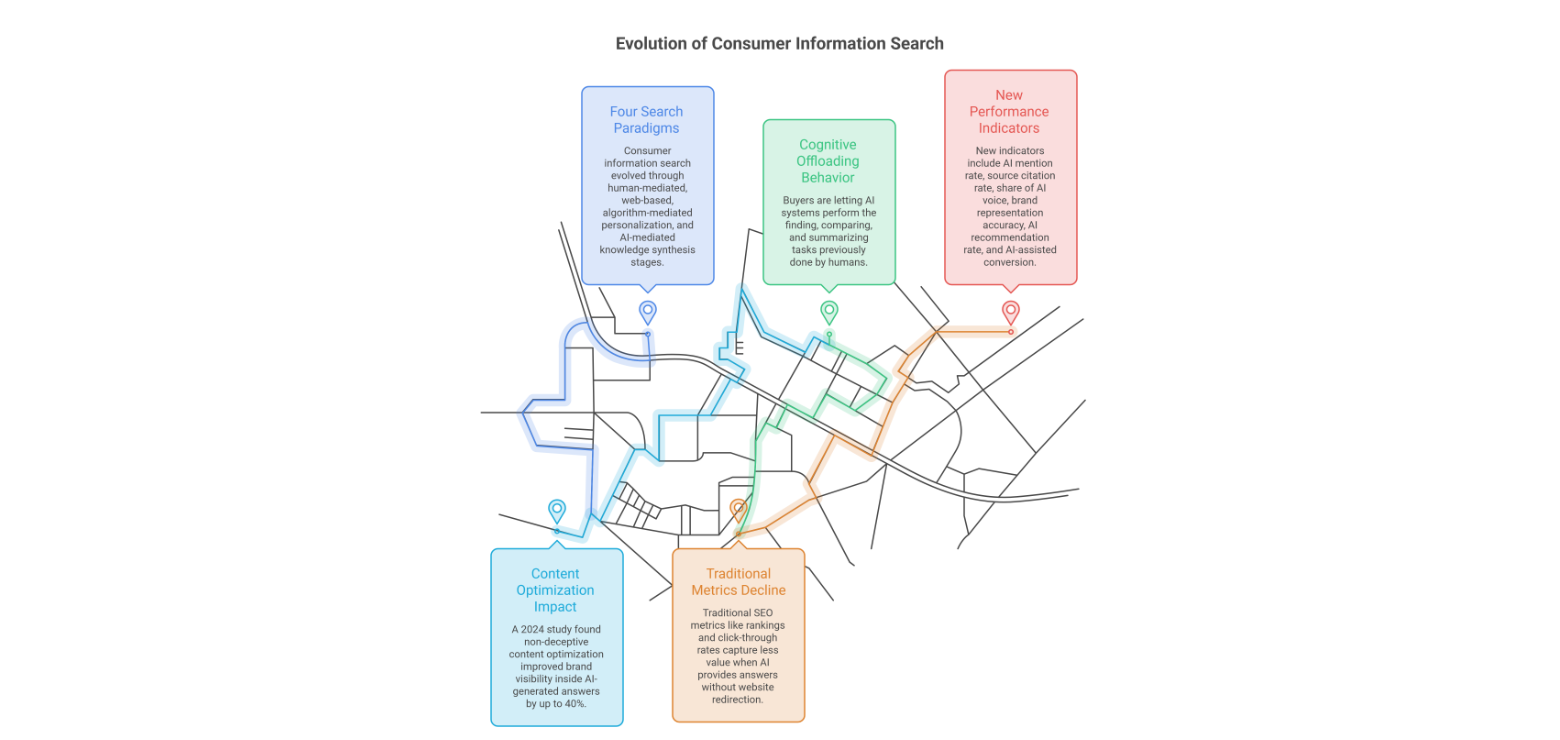
- Consumer information search has evolved through four distinct paradigms: human-mediated, web-based (SEO-driven), algorithm-mediated personalization, and now AI-mediated knowledge synthesis, and each new stage layers on top of the last rather than replacing it outright.
- A foundational 2024 study found non-deceptive content optimization improved a brand’s visibility inside AI-generated answers by up to 40%, though the effect varies significantly by industry and query type.
- Researchers describe a behavior called cognitive offloading: buyers are increasingly letting AI systems do the finding, comparing, and summarizing that used to be their own job, which changes what “being found” even means.
- Traditional SEO metrics- rankings, impressions, click-through rate- are capturing less of what happens when an AI system gives an answer without directing the user to a website, per the same 2026 review.
- New performance indicators are emerging to replace them: AI mention rate, source citation rate, share of AI voice, brand representation accuracy, AI recommendation rate, and AI-assisted conversion.
What Does "AI Replacing Search" Actually Mean?
In generative engines, the mechanics of that motion are completely different. While ChatGPT, Gemini, Perplexity, and Google’s AI Overviews can retrieve and rank documents, they can also interpret the question and then pull information from multiple sources and stitch it together into a single natural-language response. The review is point-on-point on how this affects visibility: an organization can now be visible, not by ranking a webpage, but by having its information selected, synthesized, and presented within the answer, which the buyer does not go back to, whether it be a citation, a paraphrase, or a blended explanation. The only thing that businesses are competing for is no longer to get into the results page. They are in competition for the representation within the answer.
The Four Stages Your Buyers Already Passed Through
Search Paradigm | How Buyers Obtained Information | What Visibility Required |
Human-Mediated Search | Word of mouth, trusted contacts, traditional media, and personal recommendations | Strong reputation, credibility, and referral networks |
Web-Based Search (SEO Era) | Search engines, ranked links, websites, and comparison across multiple sources | High SERP rankings, keyword relevance, quality content, and link authority |
Algorithm-Mediated Personalization | Recommendation engines, personalized search results, social platforms, and algorithmic feeds | Relevance signals, behavioral data, personalization, and platform presence |
AI-Mediated Knowledge Synthesis | AI-generated answers that retrieve, combine, and synthesize information from multiple sources into a single response | Citation visibility, accurate brand representation, source authority, and inclusion in the generated synthesis |
Critically, the review is explicit that these paradigms coexist rather than replace one another; a buyer might still ask a friend, still scroll a ranked results page, and still ask ChatGPT to summarize the options, sometimes within the same afternoon. That’s the “hybrid search ecosystem” the research describes: a purchase journey that begins on a conventional search engine, continues through a conversational AI system, and loops through social platforms and a company’s own site before it ever reaches a decision. A business that only shows up in one of those four lanes is invisible for the parts of the journey happening in the other three.
Why Your Buyers Are Offloading Their Research to AI
What This Means for Where Your Next Customer Finds You
This is where part of the useful distinction between three disciplines that are frequently used interchangeably but are not identical becomes apparent. The objective of Search Engine Optimization (SEO) is ranking and visits. Answer Engine Optimization (AEO) is all about creating concise, structured content that can be easily extracted and displayed directly in a Featured Snippet or voice response.
New KPIs for a Buyer Journey That No Longer Clicks
The Bottom Line: How The Chimera Marketing Helps Orange County Businesses Own the New Buyer Journey
This is exactly what The Chimera Marketing was created for. At YAR, as a generative engine optimization agency in Orange County, CA, we don’t see GEO as an SEO tactic that’s separate from our paid funnel and retention metric; we see the new buyer journey as one system, and we track AI mention rate and AI voice share about ChatGPT, Gemini, Perplexity, Claude, and Google AI Overview with the same tenacity we use for your paid funnel and retention numbers, because a buyer who doesn’t click a link is still a buyer your revenue team needs to close.
Frequently Asked Questions
Have Questions About Our Marketing Services? We Have Answers!
What is Generative Engine Optimization (GEO) and how is it different from SEO?
SEO is used to increase the webpage rank and click-through rate of the results page. Your brand’s details are more likely to be included, referenced and communicated correctly in the AI-generated response, in a synthesized answer, not a ranked list. The two work together, not in place of.
Why isn't my business showing up in ChatGPT or Gemini answers even though we rank well on Google?
Being near the top of a traditional search results page does not automatically mean that it will appear in the AI-generated synthesis, as that is how they determine ranking; the AI system can be different because the AI-generated system is based on multiple factors such as the credibility of the source, structural clarity, and citation-worthiness of the content across multiple documents, not just the quality of the links.
Who is the best generative engine optimization agency in Orange County, CA, for a growing business?
Within the right agency, GEO isn’t a standalone strategy, but rather a component of a unified revenue strategy, monitoring AI mention rate, AI voice mention accuracy, and share of AI voice from all of the major engines. Chimera Marketing is an Orange County SEO company that specializes in GEO and AI SEO.
How do I know if AI systems are representing my brand accurately?
The only true way to know, what happens to a single engine tells you almost nothing about your overall exposure, as different engines synthesize and cite different sources, and different months cite different sources in different ways.
Does GEO replace the need for traditional SEO?
No. The study is clear that while AI-generated content is a tool that can be used alongside SEO, they are not mutually exclusive and can be complementary components of the same buyer’s journey.