There is a part of “database optimization” that very few agencies will tell you: “database optimization” means two things, and you need both. The first is the most obvious one: optimizing your site’s database to load quickly and so Google can crawl it. The latter is recent, and it is what determines AI citations: organizing all the data of your business, entities, facts, catalogues, reviews, in a way that allows AI engines to get it clean and cite it with confidence. Well, this post is about both, since in 2026, they will be the same growth lever.
To an AI Engine, Your Business Is a Database
Database Optimization for SEO: The Two Layers
Database optimization for SEO used to mean one thing: make the database behind your site fast so Google rewards you. That still matters, enormously. But AI search added a second layer, and most Orange County businesses are only working on the first.
Layer 1: The site database
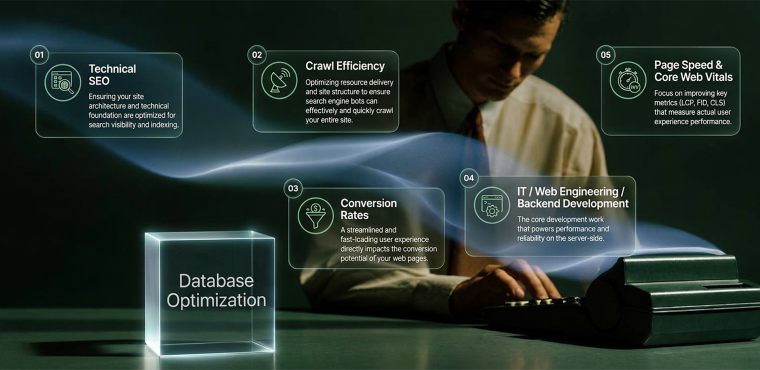
Your CMS database (usually MySQL behind WordPress) powers every page load. Bloated tables, missing indexes, and unoptimized queries slow Time to First Byte, wreck your Core Web Vitals, and burn through your site’s crawl budget. A slow site gets crawled less, indexed more slowly, and ranked lower, and rankings still feed the corpus AI engines draw from.
Layer 2: The entity database
This is the structured representation of your business across the web: schema markup, your llms.txt file, product feeds, your Google Business Profile, Wikidata-style entity signals, and consistent citations across directories. This is the layer AI engines query when they decide whom to cite.
SQL Query Optimization for Core Web Vitals
Optimizing SQL queries for Core Web Vitals is as simple as profiling slow queries (the first honest answer is the MySQL slow query log), adding the indexes that your heaviest templates require, and caching what doesn’t change. It’s an unglamorous job, and it’s a job that is really moving LCP. Remember the methodology caveat: optimizing queries makes things faster, but it doesn’t necessarily allow for AI citations. However, the speed at which you process your site determines how much of your site is processed by Googlebot or AI crawlers, and for Googlebot or AI crawlers to cite your site, they have to process it.
Improving LCP via Database Fixes
Website Speed Database Optimization: The Citation Connection
Website speed database optimization connects your backend to your frontend experience, and now, to your AI visibility. Here’s the chain, stated carefully:
- AI crawlers (GPTBot, ClaudeBot, Google’s crawlers feeding AI Overviews) operate on budgets. Slow servers get fewer pages fetched per visit.
- Pages that are never fetched never enter retrieval indexes.
- Retrieval indexes are what get cited.
The revenue angle also comes into play: Database latency and conversion rates are one of the most well-known relationships in web performance. Google uncovered itself to be a mobile research company when it reported that even small increases in page load time (from one second to three seconds) made the probability of a bounce spike, and each second of delay causes a significant drop in conversions. It’s a one-second database delay, not a technical footnote – for an Orange County business. It’s a one-second database delay, not a technical footnote – for a $5M+ Orange County business. The first repair, two rewards.
The WordPress Problem: When Plugins Become the Bottleneck
Most Orange County business sites run WordPress, and WordPress’s database design punishes growth. Every plugin stores settings in wp_options with autoload enabled; every page builder litters wp_postmeta; transients that should expire don’t. A five-year-old site can easily carry a database ten times larger than its content justifies.
A WordPress database optimization plugin, WP-Optimize, Advanced Database Cleaner, or similar, is reasonable first aid: it clears expired transients, removes orphaned metadata, and defragments tables. But treat it as triage, not treatment. Plugins clean symptoms; they don’t fix the architectural causes (a page builder issuing 200 queries per page load, a booking plugin with no indexes). If your site needs the plugin run monthly just to stay functional, the database needs engineering, not housekeeping.
AI-Driven Database Performance Monitoring
This is where the two meanings of database optimization come together: into a new practice, AI-driven database performance monitoring. In traditional monitoring, queries are performed on times and server load. The new layer observes the behavior of machine readers towards your site, such as which AI crawlers are visiting you and how frequently, what pages they’re requesting, whether your robots.txt file and your schema file(s) validate, and whether your structured data parses.
In other words, log-file analysis by crawler (are GPTBot and ClaudeBot getting fast 200s or do they time out on your catalog pages?), synthetic checks that your Organization and Product schema return valid JSON-LD, and alerts when a deploy fails to adhere to the machine-readable layer. These 2026 companies are not only fast for humans but fast for machines, too. Optimizing for blind means you can’t see what the AI crawlers can see.
Final Verdict: Database Optimization Services vs. Hiring a Consultant
The question that arises at some point is not operational: you need database optimization services, but rather, should you hire a database optimization consultant? Well, the answer is, it depends on which layer is broken. If Layer 1 is the issue- slow queries, a large WordPress database, poor Core Web Vitals- then an engagement with a consultant or a managed database tuning service USA-style retainer can resolve the issue. Well, the infrastructure work has a clear scope.
If, however, the issue is Layer 2 (you rank but AI answers don’t mention you), it’s not a DBA problem. A growth-infrastructure task is an entity strategy, structured data architecture, and retrieval engineering owned by one team and accountable to revenue vs. uptime. That’s the promise The Chimera Marketing’s Operating System is designed to fulfill: site, traffic, conversion, and retention, one instrumented machine, all with AI-native visibility built into each layer. Our 48-hour AI visibility audit is free, and it’s the quickest method to determine which layer is costing you. It’s a marketing audit, but it is a diagnostic for how ready your database is for AI engines to retrieve data from it, what it shows you are doing wrong, and what changes are going to give you the most citations. The diagnostic is left as is.