Why Ranking Alone No Longer Wins Enterprise Demand
What “Machine Readability” Actually Means
While classic SEO relies on link structure, keywords, and internal and external links, GEO places greater emphasis on semantic relevance, content quality, and E-E-A-T and integrates additional features such as structured data, conversational-query optimization, and continual content updates. Practitioner research notes the need to focus on machine scannability and justification of content, that earned media creates authority for AI engines, and that tactics must be engine-specific.
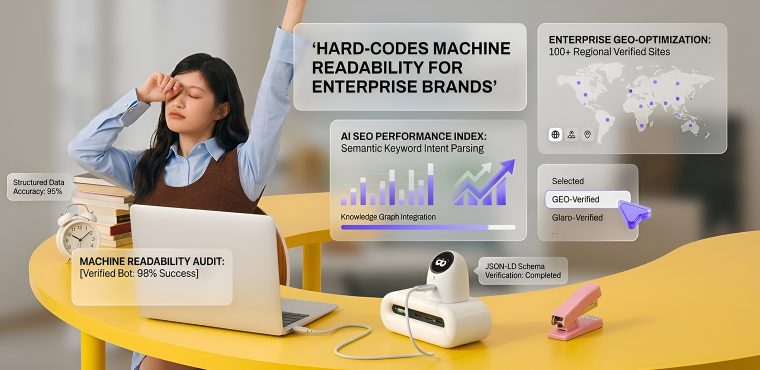
The Machine Readability Stack: Five Layers Hard-Coded Into Every Build
Chimera’s published operating model splits growth into five layers: brand, infrastructure, traffic, conversion, and retention. Machine readability runs through that structure. The sequence mirrors what a rigorous GEO engagement involves: an entity audit, structured data buildout, content remodeling, citation tracking, and ongoing prompt monitoring.
The Machine Readability Stack
Layer | What Gets Hard-Coded | Why AI Engines Care | Proof Metric |
1. Entity | Legal name, consistent description, leadership profiles, Organization and Person schema | Lets a model resolve your brand as one unambiguous entity | Entity consistency across profiles; brand recognition in test prompts |
2. Structured Data | JSON-LD for Service, FAQPage, Article, Review, and BreadcrumbList; clean heading hierarchy | Gives parsers explicit fields instead of forcing inference | % of revenue pages with valid schema |
3. Answer | A direct answer under every H2, definitions, comparison tables, question-style headings | Creates passages a model can lift cleanly | Passage-level citations on tracked prompts |
4. Evidence | Original statistics, named sources, attributed expert quotes, case-study numbers | Gives the model something it can justify citing | Citation lift on rewritten vs. original pages |
5. Authority & Measurement | Directory listings, reviews, earned media, weekly prompt tracking by engine | Engines weigh third-party corroboration | Share of citations vs. named competitors; AI-referred pipeline |
What the Research Says Actually Moves AI Visibility
From Research Finding to Page-Level Tactic
Tactic | Research Basis | How Chimera Deploys It on Enterprise Pages |
Statistics over adjectives | GEO study: statistics raise visibility | Every section opens with a sourced number, not a claim of excellence |
Named citations | GEO study: citations raise visibility | Inline attribution plus a visible references block |
Expert quotations | GEO study: quotations raise visibility | Attributed quotes from named leaders and clients |
Scannable structure | Practitioner research on scannability and justification | Descriptive H2/H3s, tables, answer-first paragraphs, FAQ blocks |
Structured data and conversational queries | Springer chapter on GEO practices | JSON-LD plus question-format headings that mirror real prompts |
Continuous updating | Springer chapter | Scheduled refresh cycle with a visible modified date |
Earned authority | Practitioner research on earned media | Directory, review, and publication presence tracked as a KPI |
Engine-specific testing | Engine preferences vary | Separate prompt panels per engine, reported separately |
There is a caveat to the research, as well. A recent critical review of GEO studies points out that the commercial claims have caught up with the science, and that outcomes are dependent on the engine, date, where the search is performed, how the query is worded, whether the search is turned on, and randomness in the generation. Anyone guaranteeing citations is guaranteeing something that is out of their control. According to one agency-evaluation guide, no agency can dictate what an AI engine will quote. Chimera promises less and is more sincere: it has control over the readability, the evidence, the measurement, and it gives results by engine.
The Orange County Advantage: Owning Local, High-Intent Queries
A full-stack GEO agency in Orange County appears in agency directories as an Anaheim digital marketing agency. This is important for AI recommendations because engines deduce geography from entity data, not content. Orange County’s portfolio of enterprises includes healthcare and medtech, hospitality and tourism, manufacturing and aerospace suppliers, real estate, financial services, and B2B software. Those buyers ask certain questions, and each question must have an answer page.
Query Map for Orange County GEO and AI SEO Demand
Query Cluster | Searcher Intent | Page Asset That Earns the Citation |
“GEO agency Orange County” / “generative engine optimization agency Orange County” | Vendor shortlisting | Service page with Service schema, areaServed, FAQ block, and verifiable proof |
“AI SEO agency Orange County” | Vendor comparison | Comparison page: AI SEO vs. traditional SEO, with decision tables |
“How much does a GEO agency cost?” | Budget qualification | Pricing-logic explainer with sourced market ranges |
“How to vet a GEO agency” | Risk reduction | Evaluation checklist that shows your own AI visibility |
“AI search optimization for enterprise brands” | Enterprise evaluation | Methodology page (this article) with the stack and roadmap |
“Why isn’t my brand showing up in ChatGPT?” | Problem-aware diagnosis | Diagnostic guide that leads to a Week-One audit |
The 90-Day Roadmap: From Audit to Compounding Citations
GEO Engagement Roadmap
Phase | Timeline | What Happens | What You Can Verify |
Diagnostic | Week 1 | Audit of site, funnel, paid, retention, and operations, plus an AI visibility baseline across a fixed prompt set | Written diagnostic of the highest-leverage revenue leaks; baseline citation share |
Instrumentation | Day 30 | Entity cleanup, schema deployment, priority pages remodeled answer-first, one reporting dashboard | Schema validation report; dashboard access |
Optimization | Day 90 | First optimization cycle: evidence layer added, engine-specific adjustments, weekly shipping cadence | Citation movement by engine; qualified-lead trend |
Compounding | Months 4–12 | Scale what earns citations, cut what doesn’t, expand authority sources | Share of voice vs. competitors; AI-referred pipeline and revenue |