
- Gemini Enterprise for CX is a post-discovery system. It converts and resolves customers who already chose you.
- Generative Engine Optimization is a pre-discovery system. It decides whether an AI engine names you at all.
- Deploying CX agents without GEO builds a conversion layer for demand that never arrives.
- The same structured content that earns AI citations also improves your agents’ own retrieval quality.
- Run both layers together, and they compound. Run one alone, and you pay for capacity you cannot fill.
What is Gemini Enterprise for CX?
Component | What it does | Where it sits |
CX Agent Studio | Builds agents combining generative and deterministic logic for proactive self-service | Mid-funnel and support |
Agent Assist | Real-time coaching, generated replies, summarization, live translation for human reps | Live conversation |
CX Insights | Surfaces KPIs, call drivers, sentiment and inquiry categories from operations data | Post-conversation |
Commerce agents | Connect chat and voice to backend tools; execute consented actions with multimodal reasoning | Transaction and fulfilment |
Why does Gemini Enterprise for CX fail without GEO?
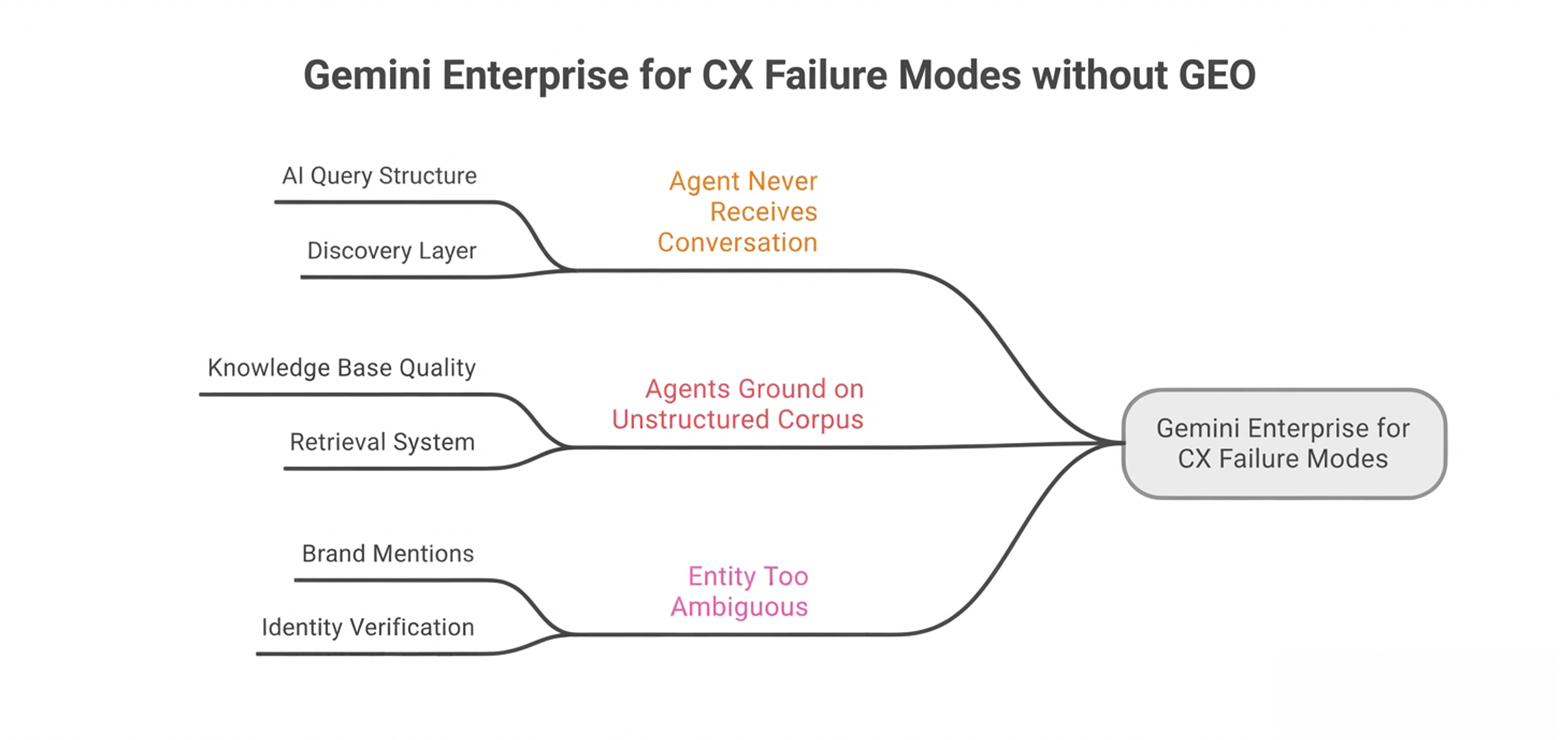
Failure 1: The agent never receives the conversation
Failure 2: Your agents ground on a corpus that was never built for retrieval
Note the operational consequence: a GEO engagement’s passage-level structuring work has a positive impact on external citation and internal agent grounding from the same build. A single remediation, two returns.
Failure 3: Your entity is too ambiguous for agents to resolve
These open web brand mentions correlate at 0.66 with AI Overview visibility, which is about three times stronger than the power of backlinks (Ahrefs, 2026). It’s not a link profile that makes you eligible to be named; it’s your entity footprint.
What does GEO actually fix in a Gemini Enterprise deployment?
Layer | Without GEO | With GEO |
Discovery | Competitors named in AI shortlists; you are absent | Brand cited across ChatGPT, Gemini, Perplexity, Claude, Copilot, AI Overviews |
Agent grounding | Agents retrieve vague prose; hedged answers | Agents retrieve dense, answer-first passages; confident resolution |
Entity resolution | Conflicting NAP and schema; models hedge | Unambiguous entity across web, schema and knowledge graphs |
Commerce agents | Idle capacity, thin session volume | Qualified sessions arriving pre-convinced by an AI recommendation |
CX Insights | Analytics on a shrinking sample | Analytics on growing, high-intent volume |
How do you measure GEO alongside your CX agents?
Traffic is the wrong north star in an answer-first market. Measure these:
- AI Share of Voice: the share of your target buyer queries where your brand is named, per engine. The headline number.
- Citation rate: how often your URLs are returned as sources, not merely mentioned.
- Agent session volume from AI referral: the direct bridge between GEO spend and your Gemini Enterprise investment.
- Agent resolution confidence visible in CX Insights. A lift here after a content restructure is GEO paying its second dividend.
- Cost per qualified lead from inbound, benchmarked against paid acquisition.
Who should run GEO alongside a Gemini Enterprise for CX rollout?
The last one is important for any CX running Gemini Enterprise. The structural work that is awarded the citation is the same as the work that brings about the retrieval of your agents. One build, two surfaces, and, as our rundown of what the best AI SEO agency in Anaheim does differently would suggest, agencies that are still using keyword density are optimizing for an old system that has been phased out.
Frequently Asked Questions
Have Questions About Our Marketing Services? We Have Answers!
Does Gemini Enterprise for CX include any GEO functionality?
No. It’s able to handle customer agents throughout the customer lifecycle from product discovery through post-purchase resolution, after a customer has already hit your surface. There’s a discipline that has to be mastered in order to earn the AI recommendation that takes them there.
Can we deploy the CX agents first and add GEO later?
It is possible, but it’s a waste of money due to sequencing. GEO reorganizes the same material that your agents start on. The agents run on a clean, retrievable corpus, rather than being rebuilt a couple of quarters later.
How do we find out whether AI engines currently recommend us?
Don’t assume, run a diagnostic. Unlike a dashboard, Chimera’s AI visibility audit gives you a fix list, ranked by severity, of what you need to improve, across four workstreams: Foundation, AI-specific signals, Authority and Content strategy.
How long does GEO take to move AI recommendations?
Technical and schema fixes are registered within weeks after content is indexed and structured. Over 90 days (9 months) of citation-driven share of voice can build up depending on the amount of authority that already exists and competitiveness of queries.
Does GEO replace SEO?
No, it runs alongside it. Google’s 2026 guidance holds that optimizing for generative AI features remains an SEO discipline. Crawlability, speed, and authority are the substrate GEO is built on.