What Every Company on the Winners List Has in Common
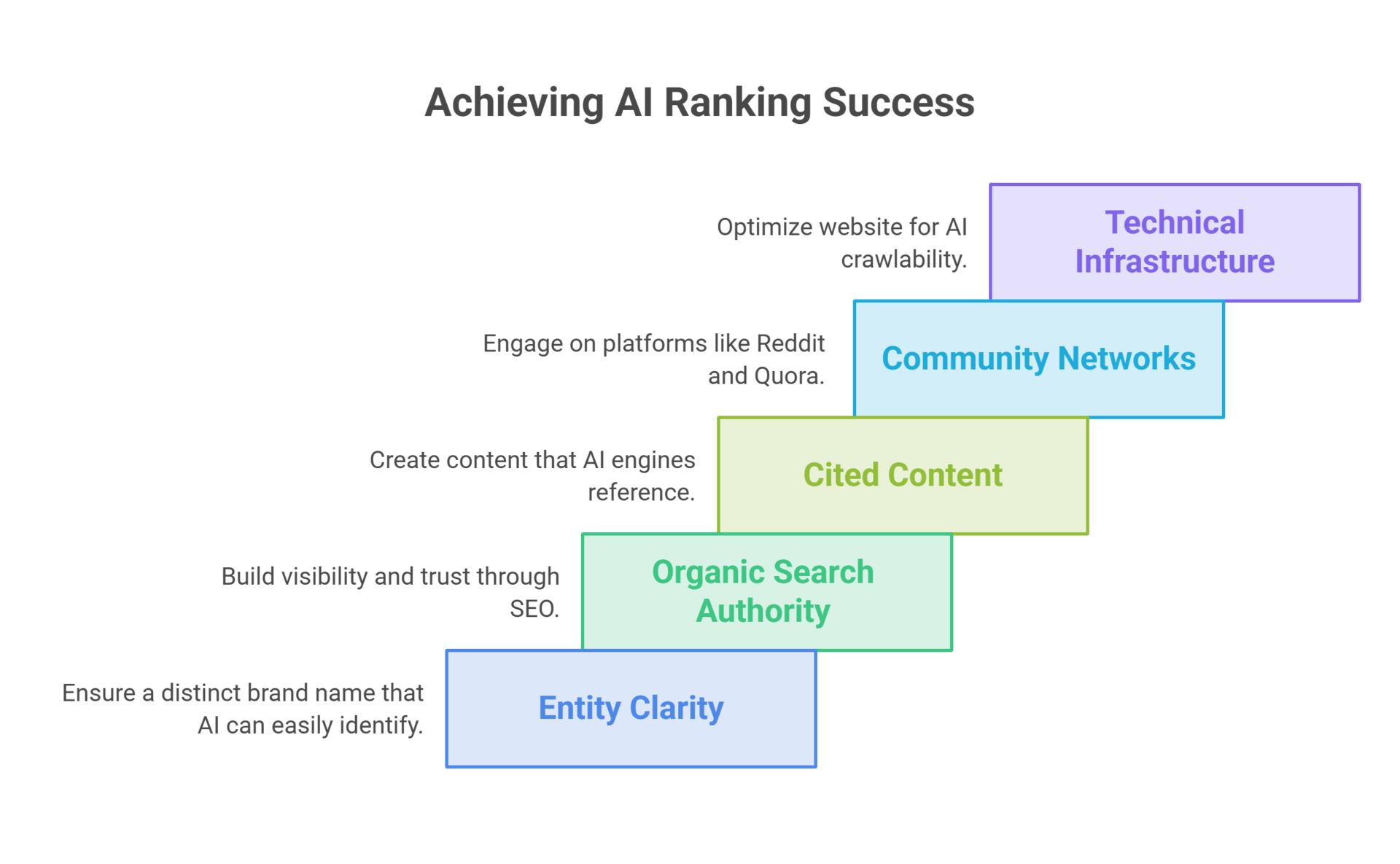
The specific companies Perplexity names in your category will differ from the ones it names in the next. But the infrastructure beneath every AI-ranked California company in 2026 is the same across five dimensions, and the absence of any one of them is usually sufficient to explain why a strong company is absent from the answers.
Entity clarity that resolves without ambiguity
The companies that can be found on the internet with AI are not doing so because of their looks. They are concerned with whether an AI model can create a coherent, consistent perception of who you are, what you do, and who you serve, not just based on your homepage, but on cross-referencing several. All companies that show up in the answers to the AI questions in California have a distinctive brand name that can be easily resolved.
Organic search authority as the prerequisite layer
The legacy of SEO is not the issue of visibility through the answer engine. Web content that is surfaced by organic search is what AI engines are trained on and retrieved from. In nearly all instances, a brand that is not visible to Google is one that lacks enough signal for AI engines to confidently attribute to a brand. Building organic authority first and then organising it for AI extraction is the key to the answer engine war victory.
Content that gets cited rather than summarised
Whether the four layers are parallel or not depends on the web infrastructure, which should be designed to enable AI engines to crawl the site, understand schemas, provide structured data, and recognize web structure and crawl depth. Without the technical components allowing easy extraction of the information, the most compelling content in the world will generate no citation value at all.
Community platform citation networks
How Reddit and Quora AEO strategy drives California AI rankings is the off-site layer most companies missing from AI answers have completely ignored. AI engines cross-reference brand mentions across community platforms as entity verification signals. A company cited only by its own website is a company a model cannot recommend with full confidence. Every winner on this list has a community presence that AI engines can independently verify.
Technical infrastructure for AI crawlability
Web infrastructure that supports AI engine crawlability, schema markup, structured data, page architecture, crawl depth, determines whether AI engines can parse the above four layers at all. The most compelling content in the world produces zero citation value if the technical layer prevents AI crawlers from accessing it cleanly.
What Keeps Most California Companies Off This List
The painful truth is that many of these are all present in their various forms in almost every California company with $5M to $30M in revenue, and none were created specifically for AI citation. They do have SEO but are not designed for AI extraction. They contain content, but it’s written for humans and not for machine retrieval. They have a website but have schema issues that prevent AI parsers from filling in the correct entity.
Why most California brands are not showing up in Perplexity and ChatGPT is the diagnostic that will explain exactly why the difference is between a company that has “working” marketing and a company that shows up in AI-generated answers, and it’s not often the marketing budget or the quality of the brand. Rather, it is a question of whether the infrastructure was intentionally designed for the references that are used by the AI engines used for the logic of the citations.
The five reasons that California businesses don’t show up in AI search is the checklist version of this diagnosis, and each of the five reasons is diagnosable, and each is correctable with the right infrastructure investment.
The marketing fragility that holds the average company back from listing on a ranking list like the AI ranking list is the growth-stage version of the same; companies that built their revenues on paid acquisition and branded search are finding out that the channel mix that gives them that revenue does not give them the signals that come from AI for the next stage of their growth. When these companies developed their marketing systems, the answer engine war was not part of the plan; the systems they developed reflect this fact.
Who Manages This Inside California's Winning Companies
One of the most useful lessons to be learned from the companies on this list is the different organizational structures that are found in the ones that are successful and the ones that are not. One of the most helpful differences between the companies on this list and the companies off the list is who is responsible for managing answer engine strategy within the winning company. The one thing these winners generally have in common is that they have a specific accountable function that owns the AEO infrastructure, rather than it being owned by an SEO manager, a content team, and a web developer who coordinate from time to time. A specialist external team either owns the full infrastructure stack or a senior internal hire has been assigned key authority and funds to develop it as a first-class priority.
The ones who aren’t on this list are more likely to have had AEO as an add-on to a current position, or on the “working on” list alongside 20 other clients that the content team is going to work on when they have time in the editorial calendar. That’s the ownership structural difference, and it’s the execution gap, which results in a citation gap, which results in a revenue gap.
This methodology document, called the AI citation playbook, is the blueprint for developing this infrastructure, the signals, content architecture, community platform strategy, and technical foundation that enable a California company to be citable, as opposed to invisible, at the intersection of Perplexity, ChatGPT, and Google AI Overviews at the same time.
The Commercial Gap Widening Every Month
The urgency this moment represents is the structural accelerant that makes 2026 AI ranking the critical battleground for Google. As traditional paid search loses ground for every dollar spent and AI Overviews are taking away more zero-click answers from the organic click pool, the California companies creating AI search authority are developing the discovery channel that will supplant both, while alternatives are paying more for less on channels that are shrinking out of business.
The citations which are being built in the training data for AI models now aren’t neutral; they are additive. In 2027, a California brand that was cited in 2026 will be more likely to be cited than one that was not cited in 2026. A brand not in the 2026 answers is working to train the next generation of models to continue the absence. Compounding is a real thing to be gained from getting the answer engine game early. It’s the business maths of getting cited 300 times per month versus 0 times per month, and the gap in the quality of pipelines, the speed of deals, and the amount of revenue.
The quality of lead generation generated by answer engine visibility is distinct from all the other inbound channels: the AI model has already recommended the search result, so the buyer already thinks the answer is good; the citation is implicitly approved as a good answer; and the buyer was already motivated by the research process to get to your article in the first place. But not because the product is better; it’s because the buying context is different by the way a lead is acquired: Answer Engine Brand Discovery leads close sooner, require less nurturing, and convert better.
This infrastructure is best created systematically, not via the tactics most agencies are peddling, but by the entity architecture, content engineering, and technical implementation that citation logic requires, and that’s the service of AI SEO automation that gets California businesses AI-ranked.
Your Name Should Be on This List
If your California company is not appearing in Perplexity’s answers in your category today, it is not because you haven’t earned the position. It is because the infrastructure that produces AI citations, the entity signals, the content architecture, the community platform presence, and the technical foundation has not been built yet to the standard these models require.
That gap is closeable. It is not closeable overnight, and it is not closeable by publishing more content or running more ads. It is closeable through a systematic infrastructure build that compounds over six to twelve months and becomes progressively harder for competitors to displace once it is established.
Audit your California AI search ranking with Chimera, and get a clear picture of where your brand currently stands in the answer engine war, what the specific infrastructure gaps are, and what it would take to put your company’s name in the 2027 version of this list.
The answer engine war is not coming. It is being fought right now in your category, and there are companies in your market already building the infrastructure to win it. The only question worth answering is whether you are one of them.